
Why TPS Replacement Windows Stay Clear, Warm & Sealed
The most important part of a window is the part you never see. TPS replacement windows finally give it the attention it deserves.
TPS replacement windows solve a problem most homeowners never think about until they see it: fog trapped between the panes, a chilly draft along the bottom of the glass, an energy bill that keeps creeping up. If your windows are doing any of that, you’re not alone. Homes across Dayton and the Miami Valley are full of aging window systems that are quietly losing the fight.
What most people don’t realize is that the problem usually isn’t the glass. It’s the spacer, the thin strip that holds the panes apart and seals the gap between them. Get the spacer right and the whole window performs. Get it wrong and nothing else matters.
That’s where TPS replacement windows come in. Here are the three benefits of this advanced spacer technology, how it compares to the alternatives, and why it holds up so well through Ohio’s freeze-and-thaw seasons.
What Is a Thermo Plastic Spacer?
Four letters that explain why some windows fog and others never do.
Instead of a pre-made metal frame bent into a rectangle and glued between the panes, a thermo plastic spacer is a flexible thermoplastic compound that a robot applies directly onto the glass. It bonds to the glass, carries its own moisture-absorbing desiccant, and has no metal and no corner joints.
Older windows relied on aluminum spacers. Aluminum conducts heat and cold extremely well, which is exactly what you don’t want at the edge of the glass. After years of expanding and contracting, those rigid frames and their corner keys loosen, the seal breaks down, insulating gas leaks out, and moisture leaks in. That’s the fog you see between the panes.
TPS replacement windows swap that rigid, conductive frame for a flexible warm edge spacer that moves with the glass instead of fighting it. For homeowners, that means fewer problems, better performance, and windows that hold up over time.
3 Benefits of TPS Replacement Windows
Three ways this spacer pays off, every season, for decades.
A seal built to last
Because TPS is applied as one seamless bead with no corner joints, there are fewer weak points where a seal can fail. The thermoplastic stays flexible, so as the glass expands in July and contracts in January, the spacer flexes with it instead of cracking or pulling away. Fewer seal failures mean fewer foggy windows, a longer service life, and the biggest reason TPS replacement windows stay clear.
A warmer edge, less condensation
Metal spacers make the bottom edge of the glass the coldest spot on the window. On a winter morning, that’s where condensation and frost form first. A warm edge spacer like TPS keeps the edge of the glass closer to room temperature, so you see less moisture and feel less chill near the glass. Our guide to window condensation in Ohio explains the rest.
Insulating gas stays put
Argon and krypton are what make modern insulated glass so efficient, but only while they stay inside. A tight, continuous TPS seal helps retain that gas longer, so TPS replacement windows keep performing like new instead of slowly losing efficiency year after year.
A bonus you can see: the TPS bead is slim and uniform, so the edge of the glass looks crisp and modern instead of bulky. Cleaner sightlines are a nice side effect of better engineering.
See the Difference at the Edge of the Glass
Pick a spacer to see what happens where the glass meets the frame on a cold Ohio morning, and why TPS replacement windows stay clearest.
Aluminum box spacer
Conducts cold straight to the inside edge of the glass. Condensation and frost form along the bottom first, and rigid corner keys are a common point of seal failure.
Silicone foam spacer
A warm edge spacer that’s a big step up from metal. It arrives as a pre-made strip, so each glass unit has a joint where the two ends meet.
TPS® thermo plastic spacer
Robot-applied in one continuous bead with no metal and no corners. The edge of the glass stays warmest, and the seal flexes with the glass through every season.
Illustration only. Actual edge temperatures vary with the glass package, frame, and installation.
TPS® vs. Super Spacer® vs. Aluminum
How the three most common spacer types stack up, and where TPS replacement windows pull ahead.
| Feature | TPS® | Super Spacer® | Aluminum |
|---|---|---|---|
| Material | Flexible thermoplastic with built-in desiccant | Silicone foam with adhesive | Hollow aluminum filled with desiccant |
| How it’s applied | Robotically extruded onto the glass | Pre-made strip applied to the glass | Bent or cut frame set between panes |
| Corners & joints | None. One continuous bead | One joint where the strip meets | Corner keys or bends |
| Metal | None | None | Yes |
| Edge of glass | Warmest | Warm | Coldest |
| Seasonal movement | Flexes with the glass | Flexes | Rigid |
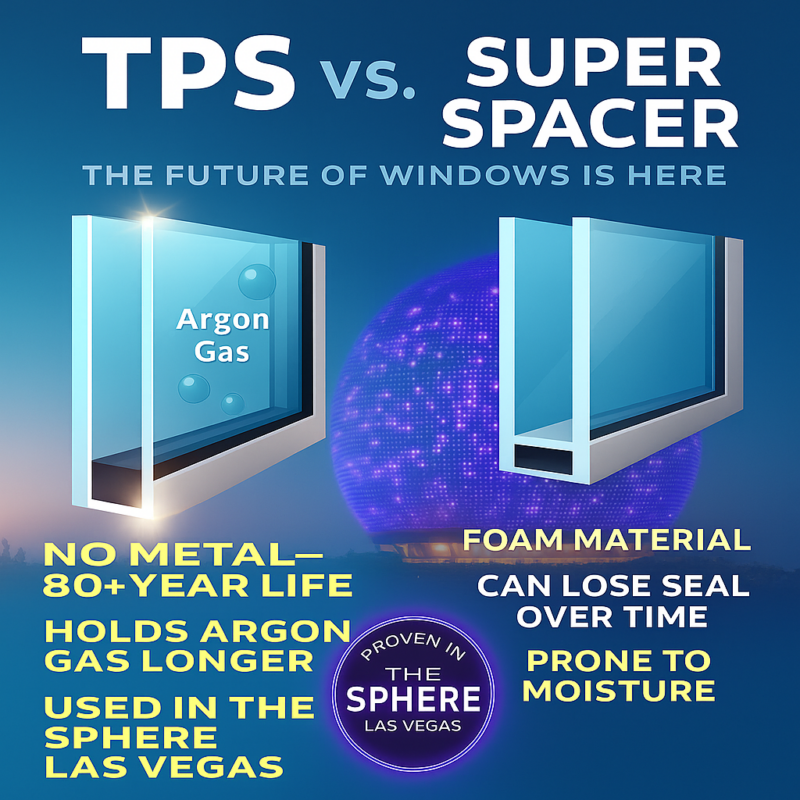
You might also encounter Super Spacer®, a silicone foam warm edge spacer. It’s a quality product and far better than metal. TPS goes a step further: it’s robot-applied for a precise, uniform seal, avoids bulky seams, and holds its insulating gas while resisting moisture over the long haul. When comparing technologies, TPS replacement windows offer cleaner sightlines and exceptional durability.
-
- TPS Replacement Windows Ohio: Cleaner Views, Tighter Seals Cleaner sightlines, moisture resistance, and lasting quality—TPS® delivers everyday clarity you can see.
-
- TPS® vs. Super Spacer® Comparison TPS® wins: no metal, better gas retention, 80+ year life—proven in The Sphere, Las Vegas.
-
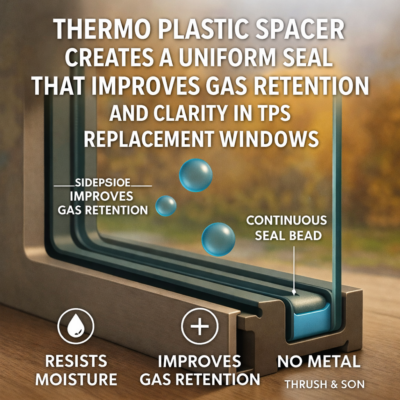
- TPS replacement windows in Ohio with tighter seals and dependable performance
Why TPS Matters Through an Ohio Year
Every season tests a window seal differently. Here’s how TPS replacement windows handle each one.
Midwest weather swings are real: hot summers, harsh winters, and everything in between. TPS flexes with the glass as temperatures change, so it’s far less likely to crack or fail. That flexibility makes TPS replacement windows a smart choice for Dayton, Centerville, Springboro, Troy, and homes across the Miami Valley that need year-round comfort and reliability.
Windows Built to Last, Inside and Out
Look beyond the glass and consider the technology between the panes.
When you’re evaluating new windows, the spec sheet tells you more than the showroom does. Our Nobility replacement windows are built around that idea, and the Platinum Collection pairs Cardinal glass with a TPS warm edge spacer for the clearest, most stable seal in our lineup.
TPS replacement windows deliver consistent comfort, lower energy use, and a cleaner finish that holds up over time, and those are benefits you’ll notice in every season. Want the vocabulary first? Our windows & doors glossary explains low-E, argon, and U-factor in plain English, and ENERGY STAR’s window guide shows how efficiency ratings work.
More tips for savingWindow Replacement Savings in Ohio: 5 Ways to Cut Energy Bills & Upgrade Your HomeFrom insulated glass upgrades to high-performance frames and installation tips, see how TPS fits into a bigger comfort-and-savings strategy.- Cardinal glass
- TPS® warm edge spacer
- Fusion-welded vinyl frames
- Lifetime Limited Warranty
Frequently Asked Questions
What homeowners ask us most about TPS replacement windows.
Do TPS replacement windows reduce condensation?
Yes. TPS creates a tighter, warmer edge seal that helps keep moisture out of the window unit and reduces condensation between the panes and along the edge of the glass.
Are TPS windows more energy efficient?
Yes. TPS reduces heat transfer at the edge of the glass compared to traditional metal spacers and helps retain insulating gas longer, which keeps indoor temperatures more consistent.
How long do TPS replacement windows last?
TPS technology is designed for long-term performance. With no corner joints and a flexible seal, it helps windows hold their seal and insulating properties for years without the common failures seen in older spacer systems.
Is TPS the same as a warm edge spacer?
TPS is one type of warm edge spacer. Warm edge simply means the spacer conducts less heat than aluminum. TPS stands out because it is applied as one continuous, metal-free bead directly on the glass, and that’s what sets TPS replacement windows apart.
How can I tell if my current windows have a failed seal?
Fog, haze, or water droplets between the panes that you can’t wipe away are the classic signs of seal failure. A failed unit has lost its insulating gas, and the problem only gets worse with time.
Talk to the Window Experts at Thrush & Son®
Not sure if your current windows are performing the way they should? We’ll walk you through exactly what’s happening at the edge of your glass and show you how TPS replacement windows can improve comfort, efficiency, and long-term performance in your home.
Schedule a Window ConsultationExplore Nobility WindowsMichelle, our AI assistant, answers 24/7 · Office: Mon–Thu 9–4, Fri 9–2 · 115 Jefferson St, Brookville, OH 45309

The Miami Valley’s Roofing & Exterior Pros
Thrush & Son® Roofing & Exterior Solutions proudly serves homeowners across Dayton and the Miami Valley. As a Best of Dayton 2024 & 2025 winner, GAF President’s Club contractor, and BBB Accredited A+ business, we’re honored to be recognized for quality and consistency. From full roof replacements and storm damage inspections to siding, windows, doors, seamless gutters, and gutter guards, we handle single-family and multi-family projects with craftsmanship you can count on.
Since 1960, our family-owned company has remained committed to integrity, performance, and lasting results. Whether you’re upgrading your roof or choosing the right casement windows, we help homeowners enhance comfort, efficiency, and value.
