
Your Attic Has to Breathe: How Ventilation Protects Your Roof and Your Energy Bill
What is attic ventilation, and why should a homeowner care about a space they rarely see? Because there are two sides to every roof. Shingles take the weather from above, and the attic decides what happens underneath: how hot the roof deck gets in July, how much moisture collects in January, and how long the whole system lasts.
Is attic ventilation worth worrying about? This guide shows how airflow works, what it does in each season, how much ventilation your attic needs, and the mistakes we find most often on Miami Valley homes.
What Is Attic Ventilation, and How Does It Work?
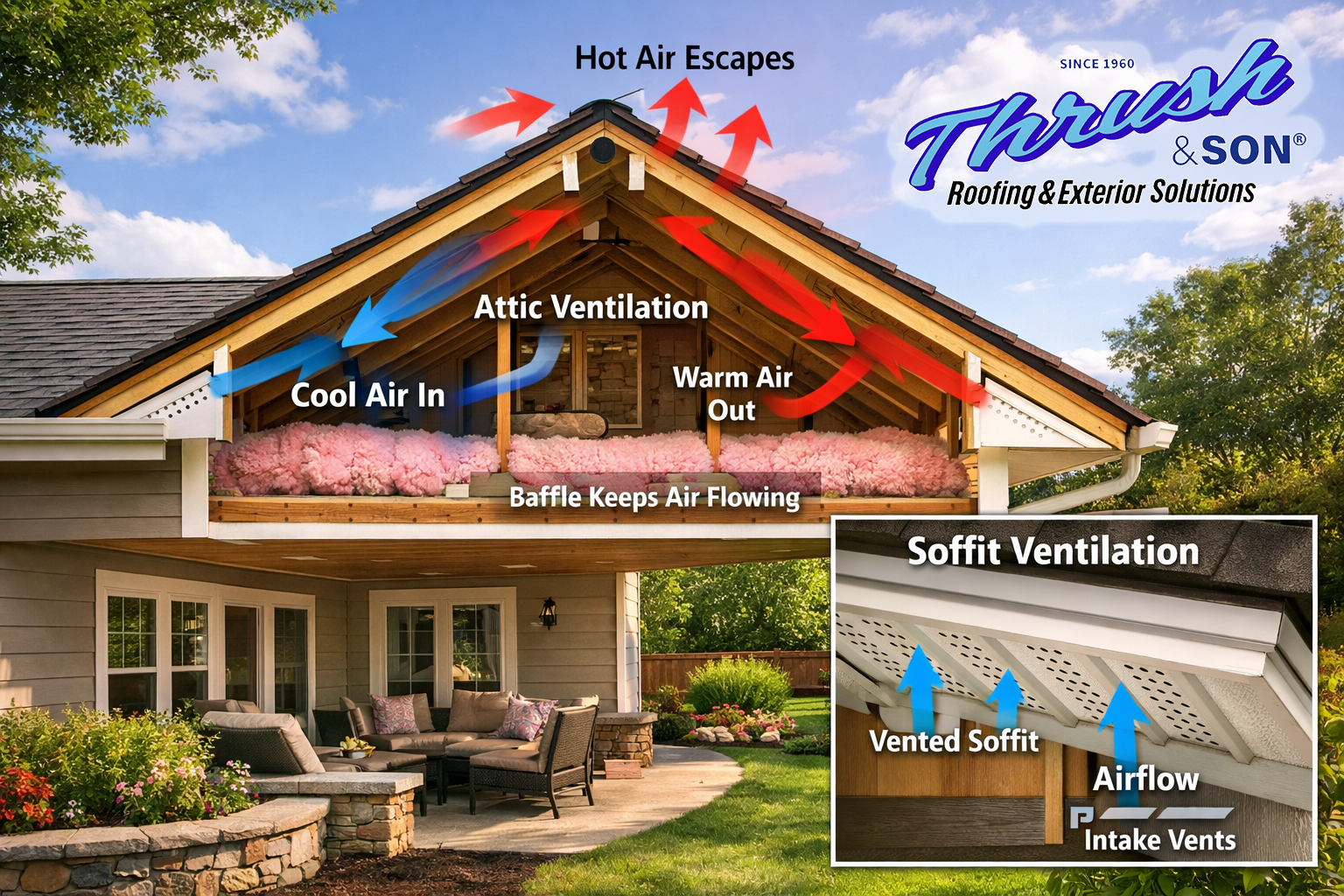
The word “ventilate” comes from the Latin for “to fan,” and that’s the idea: a steady exchange of air. So what is attic ventilation in practice? Intake vents low on the roof, usually in the soffits, let cool outside air in. Warm air naturally rises and leaves through exhaust vents near the ridge, pulling fresh air in behind it.
This is passive ventilation, and it needs no motors. It does need two things: a clear path, with baffles keeping insulation off the soffit vents, and balance. Intake should always meet or exceed exhaust, or the vents start pulling air from the house below.
Why Is Attic Ventilation Important?
Why is attic ventilation such a big deal for a roof? The Asphalt Roofing Manufacturers Association lists shingle buckling and premature roof failure among the results of poor ventilation. Here in the Miami Valley, with hot, humid summers and freezing winters, the attic works hard in both directions.
Prefer to see it? The video walks through how a balanced system moves air from the soffits to the ridge.
In summer
- Sun on the roof deck radiates heat into the attic.
- That heat pushes down through ceilings and into ductwork.
- Shingles bake from below and age faster.
- Ventilation carries the hottest air out at the ridge.
In winter
- Cooking, showers, and laundry send moisture upward.
- It condenses on cold decking and nails as frost.
- A warm attic melts roof snow that refreezes at the eaves.
- Ventilation keeps the attic dry and the roof deck cold.

Is attic ventilation the key to lower energy bills? It helps, but it isn’t magic on its own. ENERGY STAR treats ventilation and insulation as a pair, and that’s the right way to think about it. Air sealing keeps conditioned air in the house, insulation slows heat transfer, and ventilation clears what gets through. Together, they deliver real comfort and savings.
If you’re upgrading insulation too, our cellulose insulation post and insulation glossary explain the options.
How Much Ventilation Does Your Attic Need?
How much is attic ventilation supposed to be? The residential code sets the baseline at 1 square foot of net free vent area per 150 square feet of attic floor. When 40 to 50 percent of the vent area is up high near the ridge and the rest is low at the eaves, it allows 1 per 300. Pick your attic size to see the target.
Attic floor area is roughly the footprint of the living space below. Is attic ventilation on your house sized right? Compare these targets with the vents you have. Net free vent area is printed on each vent product.
- Intake (soffits)
- Exhaust (ridge)
Starting point only. Roof shape, vent products, and local code decide the final design.
Is Attic Ventilation Failing at Your House?
Is attic ventilation working at your house? The house usually tells you when airflow is off. Pick the symptom you’re seeing to find the likely cause and the right next step.
Ice dams and big icicles
- Likely cause
- Heat escaping into the attic melts roof snow, which refreezes at the cold eaves.
- What to do
- Air seal the attic floor first, then confirm balanced intake and exhaust. Our ice dam guide covers the details.
Frost on nails or decking
- Likely cause
- Warm, humid house air is reaching a cold attic and condensing on the coldest surfaces.
- What to do
- Seal ceiling penetrations, make sure bath and kitchen fans vent outdoors, and add intake if it’s short.
Hot upstairs rooms
- Likely cause
- A baking attic radiates heat down through the ceiling and into the ductwork.
- What to do
- Check that soffit vents aren’t blocked by insulation and that exhaust is sized to match.
Curling or blistering shingles
- Likely cause
- Heat and moisture trapped under the deck age shingles from below.
- What to do
- Have the ventilation checked before the next reroof. It’s the cheapest time to fix it.
Musty smell or dark stains
- Likely cause
- Moisture is lingering long enough for mold and mildew to start on the decking.
- What to do
- Find the moisture source, then fix airflow. Stains near the ridge or eaves are clues.
Cooling bills creeping up
- Likely cause
- An overheated attic and leaky ducts make the air conditioner work harder.
- What to do
- Ventilation helps, but air sealing and insulation usually deliver the bigger savings.
6 Ventilation Mistakes We Find in Dayton Attics
Most ventilation problems aren’t missing vents. They’re vents working against each other. Is attic ventilation fixable without a new roof? Often, but a reroof is the easiest time to get it right.
Soffits are half of every ventilation system, and they’re often the half that’s missing. Our soffit and fascia pages show how vented soffit pairs with a ridge vent, and our post on roof underlayment explains the layer that sits right above the deck.
When is attic ventilation easiest to correct? During a reroof, when the deck is exposed and a continuous ridge vent can be cut in cleanly. It’s one of the details we check on every Dayton roof replacement.
Attic Ventilation Questions, Answered
What is attic ventilation?
It’s the balanced flow of outside air through your attic: cool air enters low at the soffits, and warm, moist air exits high at the ridge or roof vents. That steady exchange controls heat in summer and moisture in winter.
Is attic ventilation really important for energy savings?
It helps, especially by keeping summer attic heat off your ceilings and ductwork. The biggest savings come when ventilation is paired with air sealing and good insulation, so treat them as one system.
How much attic ventilation do I need?
The residential code’s baseline is 1 square foot of net free vent area for every 150 square feet of attic floor, or 1 per 300 when the system is balanced between high and low vents. Use the calculator above for a starting point.
Can an attic have too much ventilation?
Too much exhaust without enough intake is a real problem, because the vents start pulling air from the house. Balance matters more than total size.
Is attic ventilation needed in winter?
Yes. Winter is when ventilation carries household moisture out of the attic before it condenses as frost, and when a cold roof deck prevents the melt-and-refreeze cycle that builds ice dams. Closing vents in winter does more harm than good.
Should ventilation be fixed during a reroof?
Yes. With the old shingles off, adding a ridge vent, opening intake, and correcting the balance is far easier and less expensive than doing it later.

Trusted on Miami Valley Roofs Since 1960
Wilbur Thrush founded Thrush & Son® in 1960, and the third generation leads it today. Every roof we install starts with the question of what is attic ventilation doing on this house, and we design intake and exhaust to match before a single shingle goes on.
Not Sure Your Attic Is Breathing? We’ll Check It.
Is attic ventilation behind a hot upstairs or an icy roof edge? We’ll measure your intake and exhaust, look for moisture and blocked soffits, and tell you plainly whether your attic needs a fix now or can wait for the next roof.
- GAF President’s Club Contractor
- Best of Dayton 2024 Winner · 2025 & 2026 Finalist
- BBB Accredited A+
Michelle, our AI assistant, answers 24/7
Office: Mon–Thu 9–4, Fri 9–2
