
How Deep Is Deep Enough? 5 Facts About Cellulose and the Insulation Mistakes That Backfire
Cellulose insulation is shredded, recycled paper treated with fire retardant and blown into attics and wall cavities, where it packs around wires, pipes, and odd framing that batts can’t fill. It’s one of the most practical upgrades for older homes because it goes in without tearing anything apart.
But depth is only half the story. Too little and heat pours through the ceiling; in the wrong places, even the right amount causes moisture, ice dams, and safety problems. Here’s what the numbers really mean for a Dayton attic.
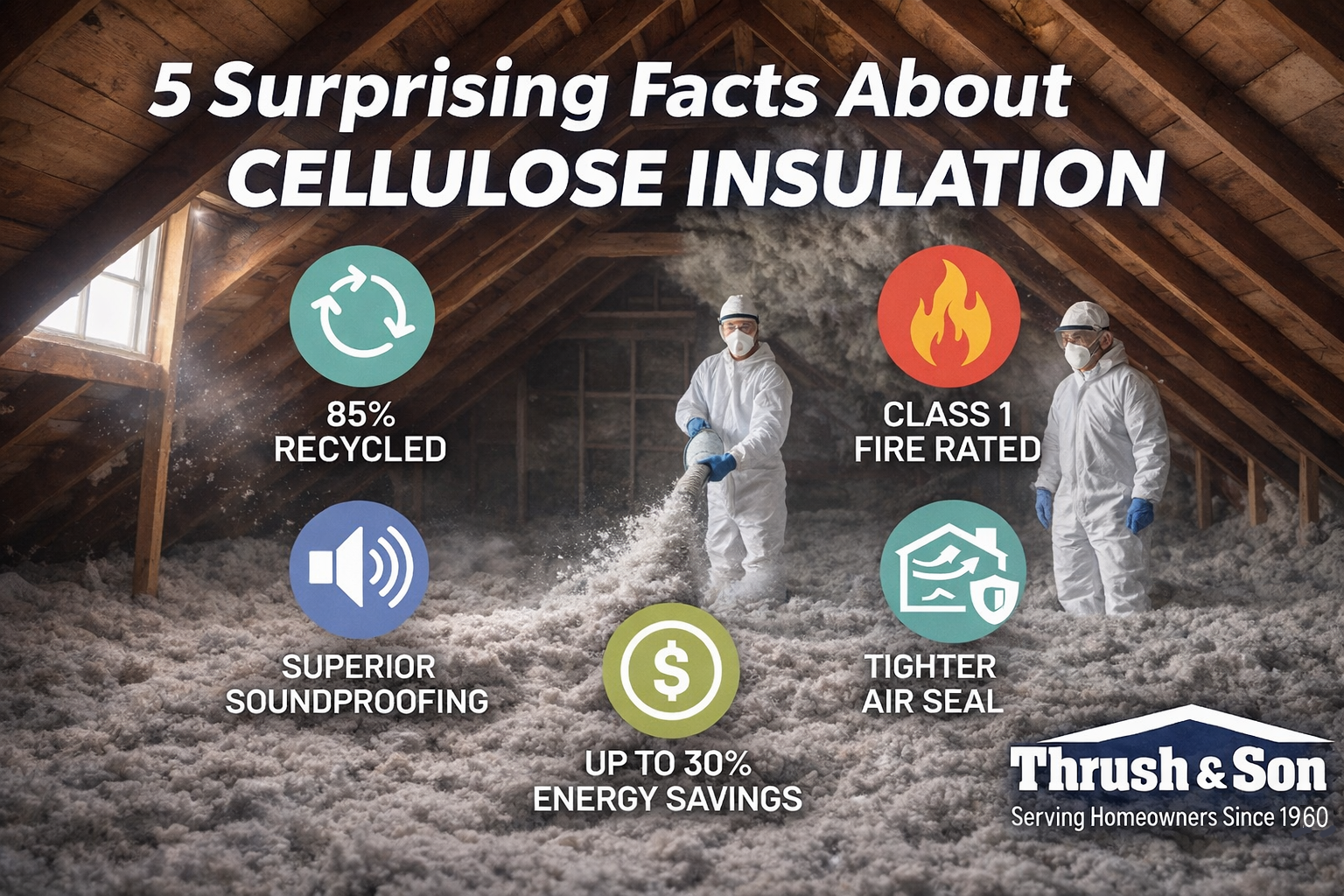
5 Facts About Cellulose Insulation
What makes cellulose insulation different from the pink batts most people picture? Five things worth knowing before anyone fires up a blowing machine in your attic.
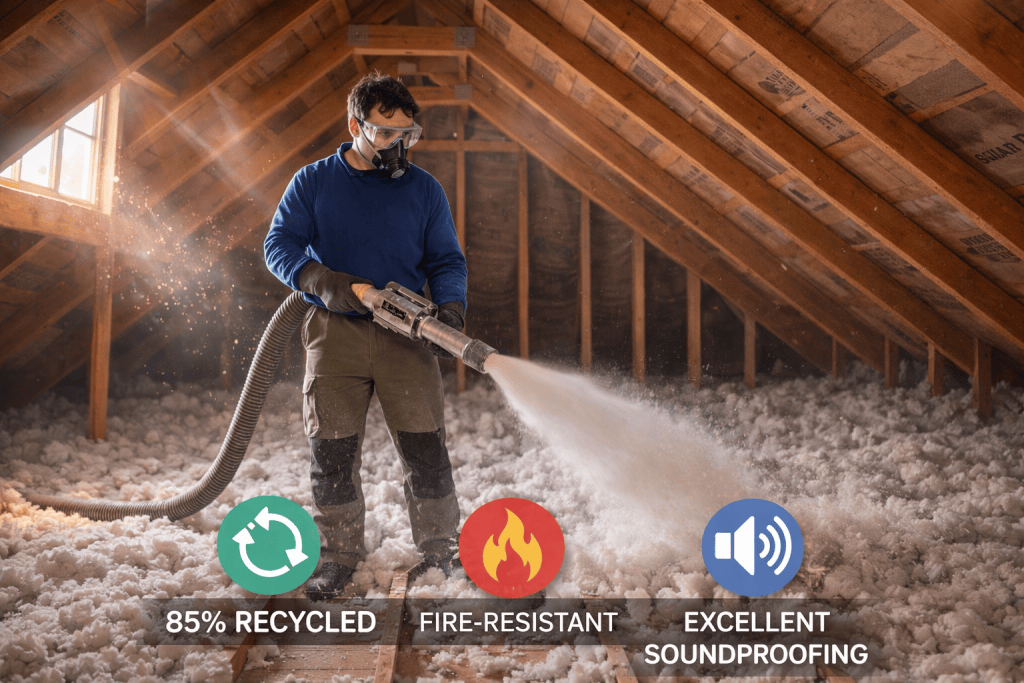
One caution comes with all that density: cellulose insulation absorbs water. A one-time drip from a ridge vent will usually dry out, but a slow, steady roof leak can soak it and stay hidden until a ceiling stains. That’s another reason a sound roof and good flashing matter before you insulate.
Fine Homebuilding’s comparison of blown fiberglass and cellulose covers the settling and air-leakage differences in more depth.
Insulation Depth and R-Value: See What Each Inch Buys
Pick a settled depth of cellulose insulation to see its R-value and how much heat still flows through your ceiling compared with no insulation at all. Watch how the savings shrink as you go deeper.
Assumes R-3.2 per inch plus about R-2 for the ceiling itself. Real results vary with air sealing and installation.
- Heat flow vs. bare ceiling
- 100%
- Cut vs. bare ceiling
- 0%
- Next step saves
- 84.6 points more
A bare ceiling. Heat moves straight through the drywall into the attic.
- Heat flow vs. bare ceiling
- 15%
- Cut vs. bare ceiling
- 85%
- Next step saves
- 5.9 points more
Typical of older Miami Valley homes. The first few inches do the most work.
- Heat flow vs. bare ceiling
- 10%
- Cut vs. bare ceiling
- 90%
- Next step saves
- 3.1 points more
About R-19. A big improvement, but well short of today’s targets.
- Heat flow vs. bare ceiling
- 6%
- Cut vs. bare ceiling
- 94%
- Next step saves
- 1.5 points more
About R-29. Comfort improves, and upstairs rooms stop swinging as much.
- Heat flow vs. bare ceiling
- 5%
- Cut vs. bare ceiling
- 95%
- Next step saves
- 1.2 points more
About R-38. The ENERGY STAR target is R49 if you’re topping up 3 to 4 inches, R60 for a bare attic.
- Heat flow vs. bare ceiling
- 4%
- Cut vs. bare ceiling
- 96%
- Next step saves
- 0.7 points more
About R-50. You’ve reached the zone 5 target for topping up an existing layer.
- Heat flow vs. bare ceiling
- 3%
- Cut vs. bare ceiling
- 97%
- Next step saves
- 0.4 points more
About R-61. The ENERGY STAR target for an uninsulated attic in zone 5.
- Heat flow vs. bare ceiling
- 3%
- Cut vs. bare ceiling
- 97%
- Next step saves
- Little to nothing
About R-70. Past the target. Each added inch now saves very little, and weight and clearance start to matter.
Why the curve flattens
Heat flow drops with the inverse of R-value. Going from bare drywall to 6 inches cuts ceiling heat loss by about 90 percent. Going from about 15 to 19 inches trims less than one more point of the original loss, though that’s still about a sixth of what’s left. That’s why ENERGY STAR’s recommended R-values stop at R60 for zone 5: up to there, the remaining savings add up over decades. Beyond it, extra cellulose insulation adds cost and weight faster than savings.
Blow to the installed line
Because cellulose insulation settles, installers blow it deeper than the target and let it settle down to the rated depth. The manufacturer’s bag chart lists both numbers. Ask for depth rulers stapled to the trusses so you can check it yourself, and if you see a ruler at the settled line on day one, the attic is under-filled.
When More Insulation Backfires
The most common insulation problem we find isn’t too little. It’s cellulose insulation blown where it doesn’t belong. Switch between the three eave conditions below to see how the same material helps or hurts.
Done right
Baffles hold cellulose insulation back from the roof deck, soffit air flows freely, and the attic floor was air sealed first.
- Baffles at every rafter bay over a soffit vent
- At least 1 inch of air space under the roof deck at the vents
- Air sealing at wires, pipes, and top plates before blowing
- IC-rated fixtures or covers over recessed lights
Soffits buried
Insulation blown right to the roof deck seals off the intake vents. The attic stops breathing.
- Moisture condenses on cold decking in winter
- Frost, mold, and rot start at the eaves
- Warmer roof edge feeds ice dams
- Exhaust vents start pulling air from the house
Crushed and buried
Too much in tight spots compresses the insulation and covers things that should stay clear.
- Compressed insulation at the eaves loses R-value
- Non-IC recessed lights can overheat
- Bath fan ducts and junction boxes get lost
- Heavy layers can sag older ceilings

Baffles are cheap, and skipping them is expensive. The residential code calls for at least 1 inch of air space between the insulation and the roof sheathing at the vents. A baffle in every rafter bay keeps that channel open while the cellulose insulation runs all the way to the wall plate, where the house needs it most.
Insulation and ventilation are one system. Our guide Is Attic Ventilation Important? shows how intake and exhaust have to balance, and our insulation glossary defines baffles, R-value, and air sealing in plain terms.
Cellulose vs. Blown Fiberglass
Both are good attic products when they’re installed right. The differences show up in density, air resistance, and how each one handles settling and water. For most retrofit attics in the Miami Valley, cellulose insulation is our first recommendation, especially over older ceilings full of gaps.
Thinking about walls, too? Dense-packed cellulose can be blown into closed wall cavities through small holes. When the siding comes off anyway, that’s the time to fill empty walls; see our insulated vinyl siding page for adding a continuous layer outside.
Typical values. Check the product’s coverage chart for exact figures.
Cellulose Insulation Questions, Answered
How deep should cellulose insulation be in a Dayton attic?
Dayton sits in climate zone 5. ENERGY STAR recommends R60 for an uninsulated attic and R49 when you’re adding to 3 to 4 inches. At about R-3.2 per inch, that’s roughly 19 inches and 15 inches of settled cellulose.
Can you have too much insulation in an attic?
Not in R-value terms, but you can put it in the wrong places. Burying soffit vents without baffles, covering non-IC recessed lights, or compressing cellulose insulation at the eaves causes moisture, heat, and comfort problems.
Do I need baffles with blown cellulose?
Yes, wherever soffit vents bring air into the attic. Baffles keep at least 1 inch of air space under the roof deck so intake air can reach the attic while the cellulose insulation runs all the way to the wall plate.
Is cellulose insulation better than fiberglass?
For attics it offers more R-value per inch and better air resistance. Fiberglass doesn’t settle and shrugs off minor moisture. Both work when installed correctly; the installation matters more than the label.
Should the attic be air sealed before insulating?
Yes. Insulation slows heat, but it doesn’t stop air. Sealing gaps around wires, pipes, lights, and top plates first keeps warm, moist house air out of the attic and makes every inch of cellulose insulation more effective.
Family-Owned Since 1960
Thrush & Son® has served Miami Valley homeowners since Wilbur Thrush founded the company in 1960, and the family still runs it three generations later. When we install cellulose insulation, we air seal first, baffle every vented bay, protect fixtures, and leave depth rulers you can read.

Find Out What’s Really in Your Attic
We’ll measure your current depth, check baffles and soffit intake, look for air leaks and moisture, and give you a written plan for cellulose insulation sized to Dayton’s climate. Call (937) 833-5136 or schedule online.
- GAF President’s Club Contractor
- Best of Dayton 2024 Winner · 2025 & 2026 Finalist
- BBB Accredited A+
Michelle, our AI assistant, answers 24/7
Office: Mon–Thu 9–4, Fri 9–2
