
Roof Anatomy 101: Every Layer, Edge, and Seal Explained
The parts of a roof work as one system against Ohio rain, snow, ice, wind, and sun. Shingles get the attention, but what keeps water out is everything working together underneath them.
This lab takes the parts of a roof apart five ways. Tap through each interactive specimen to see what every part does and where it lives on your house.
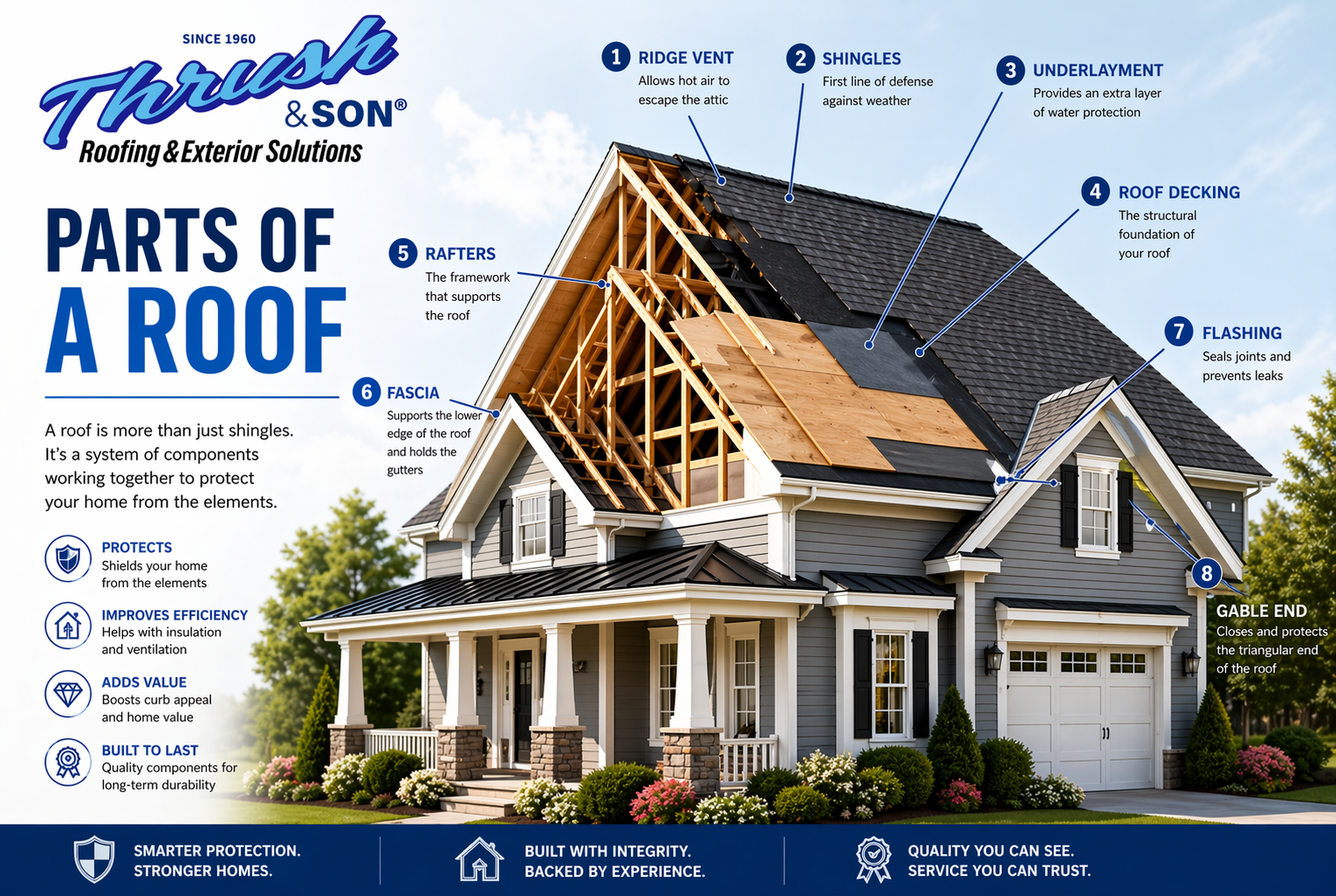
The Parts of a Roof You Can See From the Yard
Start outside. Every roof, simple or complex, is built from the same few pieces. Tap a part to light it up on this roof plan, viewed from above.
Ridge
The horizontal line at the very top, where two slopes meet. It’s capped with ridge cap shingles and, on most of our roofs, hides a ridge vent that lets attic air out.
Eaves
The bottom edges of each slope, where water leaves the roof and enters the gutter. Ice dams form here, which is why eaves get a leak barrier and a metal drip edge.
Rakes
The slanted edges at a gable end. Wind tries to peel shingles here first, so the starter strip and edge metal matter as much here as at the eaves.
Valleys
An inside corner where two roof planes meet and channel water together. Valleys carry more water than any other part of a roof, so they get a leak barrier underneath.
Field
The open surface of each slope, covered by courses of shingles over underlayment and decking. It’s the part everyone sees from the street.
Penetrations
Chimneys, skylights, plumbing vents, and exhaust vents. Every one is a deliberate hole in the roof that has to be flashed and sealed.
Knowing the parts of a roof by name helps when you read an estimate or talk with an adjuster. Our roofing terms glossary covers the rest of the vocabulary.
Six Layers Between Your Attic and the Sky
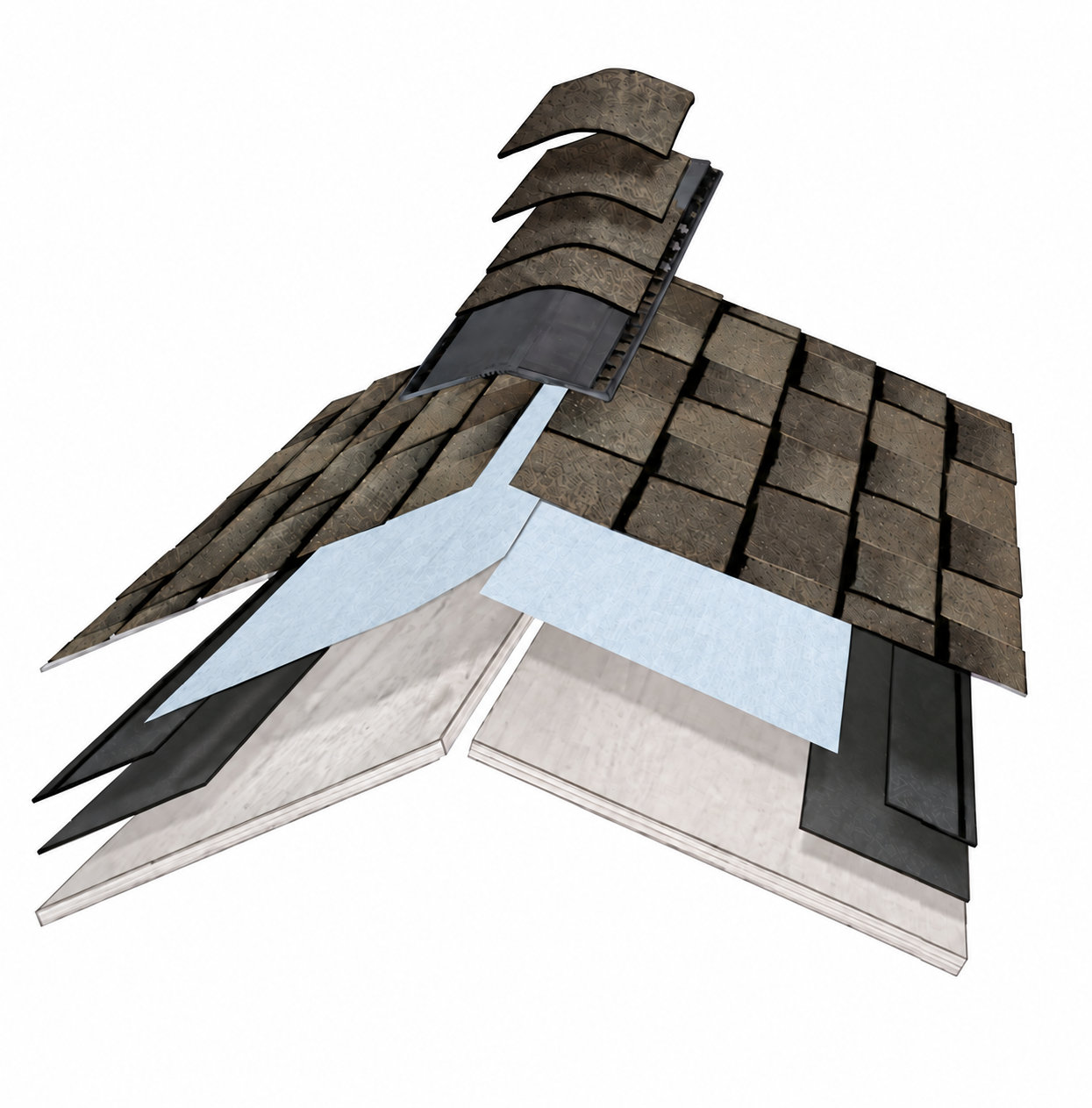
Cut a roof open and the parts of a roof stack up in layers. Tap a number to see what each one does. This is the six-layer system we install on every full replacement.
Leak barrier
A self-adhering waterproof membrane at the eaves, valleys, and around every opening. It seals around nails and stops water that ice dams push backward under the shingles.
Deck protection
Synthetic underlayment over the rest of the deck. It’s the backup layer that keeps the wood dry if wind-driven rain gets past a shingle.
Starter strip
Factory-made starter shingles along the eaves and rakes, with a strip of adhesive that locks the first row down against wind.
Shingles
Architectural shingles, the part of a roof you see. Laminated layers give them depth, and the nailing pattern decides how well they hold in a storm.
Attic ventilation
Intake at the soffits and exhaust at the ridge, working as a pair to move heat and moisture out of the attic.
Ridge cap
Purpose-made ridge cap shingles that bend over the peak without cracking, finishing the highest and most exposed line on the roof.
A leak barrier like GAF’s WeatherWatch goes at the eaves, valleys, and openings; the rest of the deck gets synthetic underlayment. For more depth, see roof underlayment and roofing components.
Flashing: The Small Parts of a Roof That Stop Big Leaks
Anywhere the roof meets a wall, a chimney, a skylight, or a pipe, shingles alone can’t keep water out. Flashing does. Tap a number to find each kind.
Simplified roof plan. Real roofs combine these details in different ways.
Chimney
Step flashing weaves into the shingles, and counterflashing set into the mortar folds down over it. Wide chimneys also get a cricket that splits water around the back.
Sidewall
Where a roof runs up a wall, every shingle course gets its own L-shaped piece, overlapping like the shingles, with the siding lapped over it.
Kickout
A small angled piece at the bottom of a roof-to-wall run that kicks water into the gutter instead of behind the siding.
Valley
Valleys get a leak barrier underneath, then a metal liner or shingles cut in a clean line along the center.
Plumbing vent
A flashing base with a rubber collar that hugs the pipe. The collar weathers over time and is replaced during a reroof.
Skylight
A flashing kit made for that skylight: side pieces, a head flashing at the top, and an apron at the bottom.
Roof-to-wall details carry the most risk of all the parts of a roof. The Department of Energy’s Building America program shows how step and kickout flashing should be layered, and our #1 roof flashing mistake guide covers what goes wrong.
Ventilation: The Part of a Roof You Never See
Of all the parts of a roof, ventilation is the easiest to skip because you can’t see it from the street. Cool air comes in low at the soffits, and warm, moist air leaves high at the ridge. ENERGY STAR explains that good attic ventilation helps remove moisture in winter and heat in summer.
Balance matters more than size. Our attic ventilation guide has a calculator and the mistakes we find most often.
Peel the Roof Down to Its Bones
Now strip it. Tap each step to remove a layer and see what the parts of a roof are resting on.
Shingles on top, doing the visible work: shedding water and taking the sun, wind, and hail.
Underneath is the underlayment and, at the edges, the leak barrier. This is the second line of defense.
Now you see the decking: plywood or OSB sheets nailed to the framing. Soft or rotted spots get replaced during a reroof.
The bones: rafters or trusses that carry the whole roof, ending at the fascia board with the soffit underneath.
At the edge, two more parts of a roof meet: the fascia board caps the rafter ends and holds the gutters, while the soffit closes in the underside and feeds air to the vents. On a reroof we check the decking sheet by sheet, because new shingles are only as solid as the wood they’re nailed to. Ice is the other big test of the edge; see ice damage.

Every Part, Installed as One System
Wilbur Thrush founded Thrush & Son in 1960. W. Allen Thrush owns the company today, and Corey Thrush is the third generation. More than 31,000 Miami Valley homeowners have trusted us, from our Brookville headquarters and offices in Troy and Lebanon.
As a GAF President’s Club Contractor, we install all the parts of a roof as one GAF system, which is what qualifies a roof for GAF’s strongest warranties. See our roofing services, the project gallery, and homeowner reviews.
Parts of a Roof: Your Questions, Answered
What homeowners ask us most about the parts of a roof.
What are the main parts of a roof?
Outside, the ridge, eaves, rakes, valleys, field, and penetrations. Underneath, the leak barrier, underlayment, starter strip, shingles, ridge cap, flashing, ventilation, and decking, all resting on rafters or trusses.
Which parts of a roof leak most often?
Flashing and penetrations: chimneys, walls, skylights, and pipe boots. Valleys and eaves come next, especially when ice dams back water up under the shingles.
What’s the difference between underlayment and a leak barrier?
Underlayment covers the whole deck as a backup layer. A leak barrier is a self-adhering membrane that seals around nails and goes in the trouble spots: eaves, valleys, and around openings.
Why does attic ventilation count as a part of a roof?
Because it changes how long the rest lasts. ENERGY STAR notes that ventilation helps remove moisture in winter and heat in summer. See our attic ventilation guide.
What is roof decking?
The plywood or OSB sheathing nailed over the rafters or trusses. Everything else on the roof is fastened to it, so damaged decking is replaced before new shingles go on.
Do all parts of a roof get replaced in a reroof?
On a full replacement, everything above the decking is new, and damaged decking is replaced. The framing usually stays unless it’s damaged.
Get an X-Ray of Your Own Roof
We’ll inspect all the parts of a roof on your house, from the ridge to the decking, show you photos of what we find, and give you a written plan with no pressure. Storm damage? See storm damage help, and ask about financing.
Call 937-833-5136 · Office: Mon–Thu 9–4, Fri 9–2 · Michelle, our AI assistant, answers 24/7
