
Who Wants to Know in 2015 What a Green City Could Look Like? The Ultimate Guide
A Green City is a place where buildings, streets, and the people living in them work with the climate instead of against it. It uses fewer natural resources, produces as much energy as it consumes, and keeps its residents healthier. When we first published this in 2015, that was mostly a planner’s conversation. Ten years later, stricter energy codes, reflective roofing, and stormwater rules have carried many of those ideas into ordinary neighborhoods.
I grew up on job sites, and the longer you spend on roofs and in attics, the clearer one pattern gets: a house that wastes energy, water, or material almost always has the same few weak points. A city is thousands of those houses added together. So the most useful way to picture a Green City is to start at the roofline and work outward.
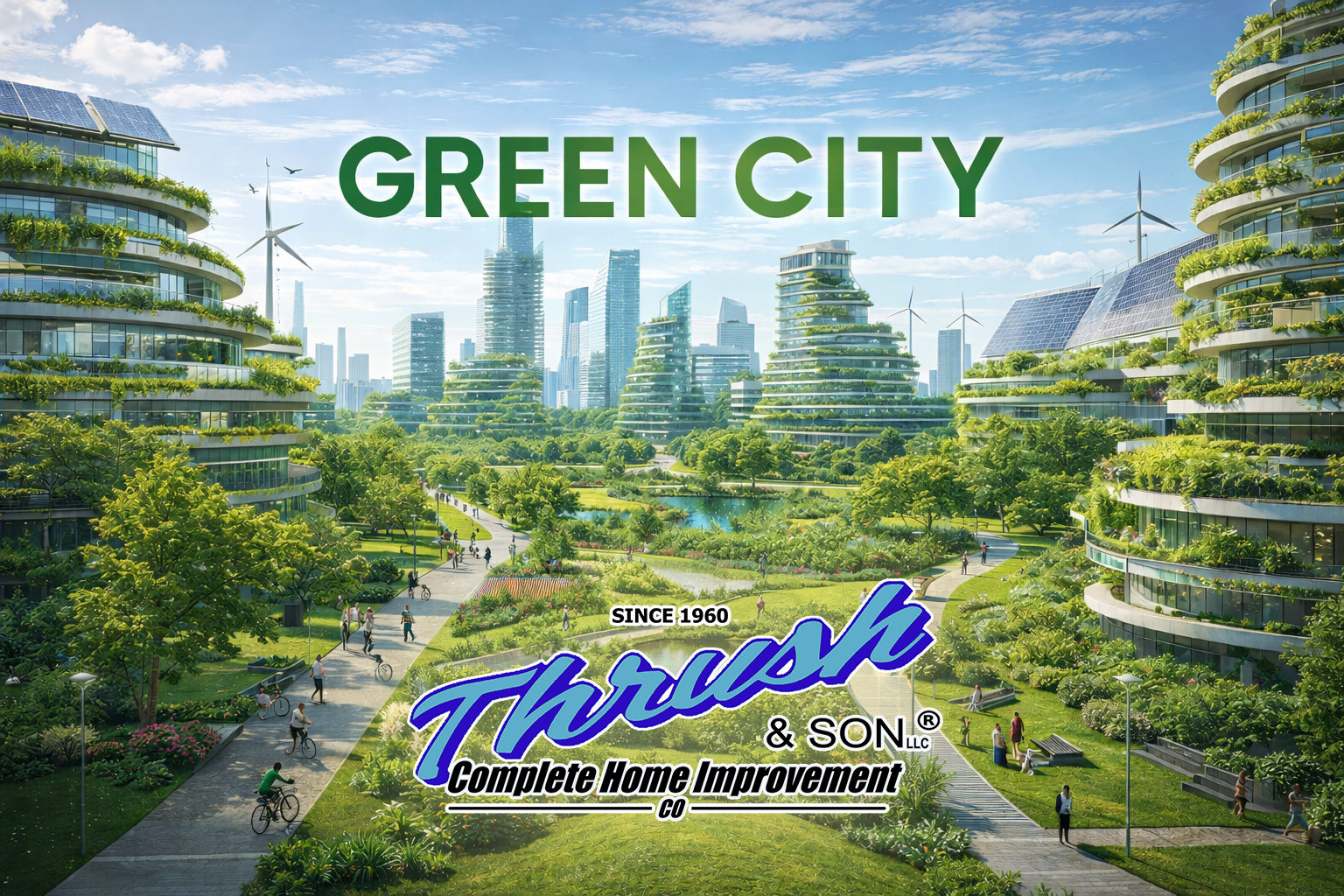
Net-Zero Starts With What You Stop Wasting
A net-zero building produces as much energy as it uses over a year. Most people jump straight to solar panels, but the order of the work matters more than the equipment. Every kilowatt-hour you stop leaking is one you never have to generate, and generation is the expensive part.
In the homes we inspect around Dayton, the biggest losses rarely come from the furnace. They come from attic insulation that has settled to a few inches, recessed lights open to the attic, bath fans vented into the soffit, and window seals that failed years ago. Close those gaps and the array can be smaller and still cover the load. Our guide to home energy efficiency walks through each one.
A Green City gets to net-zero the same way, one tight building envelope at a time, with modern codes setting the floor. The U.S. Department of Energy Building Energy Codes Program tracks how those codes have tightened across the country.
The order we recommend
- 1Seal and insulate the atticUsually the largest, cheapest loss we find
- 2Upgrade failed windows and doorsFogged glass means the seal, and the gas fill, are gone
- 3Balance roof ventilationIntake at the eaves, exhaust at the ridge, sized to the attic
- 4Right-size heating and coolingA tighter house needs smaller equipment
- 5Add solar for what remainsNow the array covers a smaller, steadier load
Green Roofs and the Fight Against Rooftop Heat
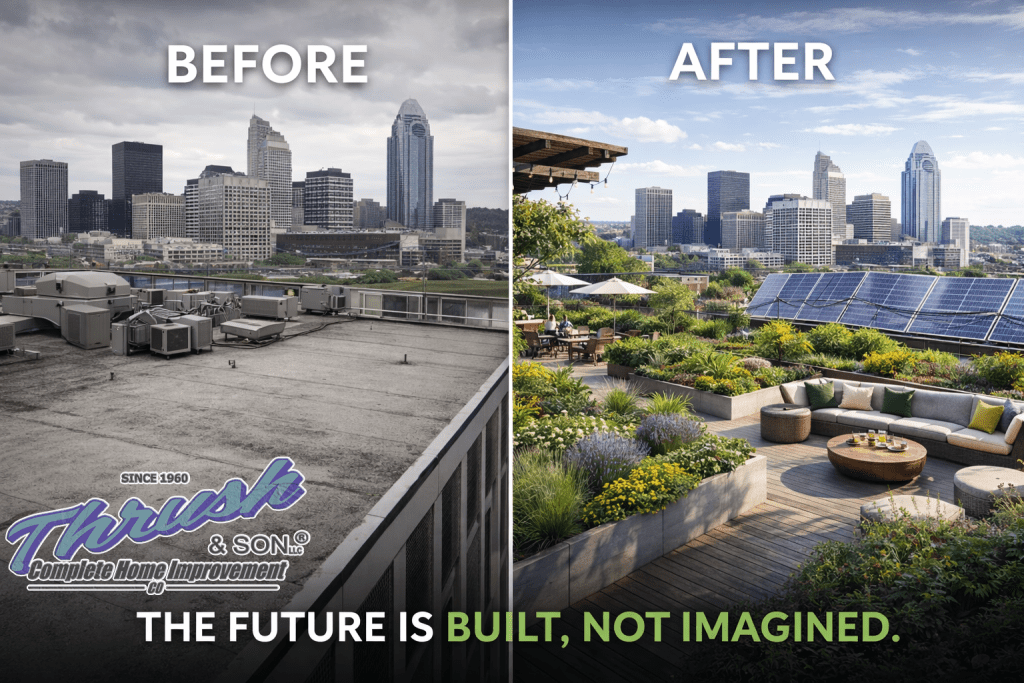
Green roofs are the image most people attach to a Green City, and they earn it. A vegetated roof holds rainwater, shades the membrane below, and turns dead space into usable space. The U.S. EPA reports green roof surfaces can run up to 56°F cooler than conventional roofs and can cut nearby air temperatures as well.
Here is what the brochures leave out. A vegetated system is a low-slope, commercial application. It needs a structure rated for saturated soil, a root barrier, and a waterproofing layer that is very hard to reach once the plants are in. On a pitched home in Ohio, the same goal, less heat soaking into the attic, comes from reflective shingles and balanced attic ventilation. See what else keeps a house cooler in our cool home exterior guide.
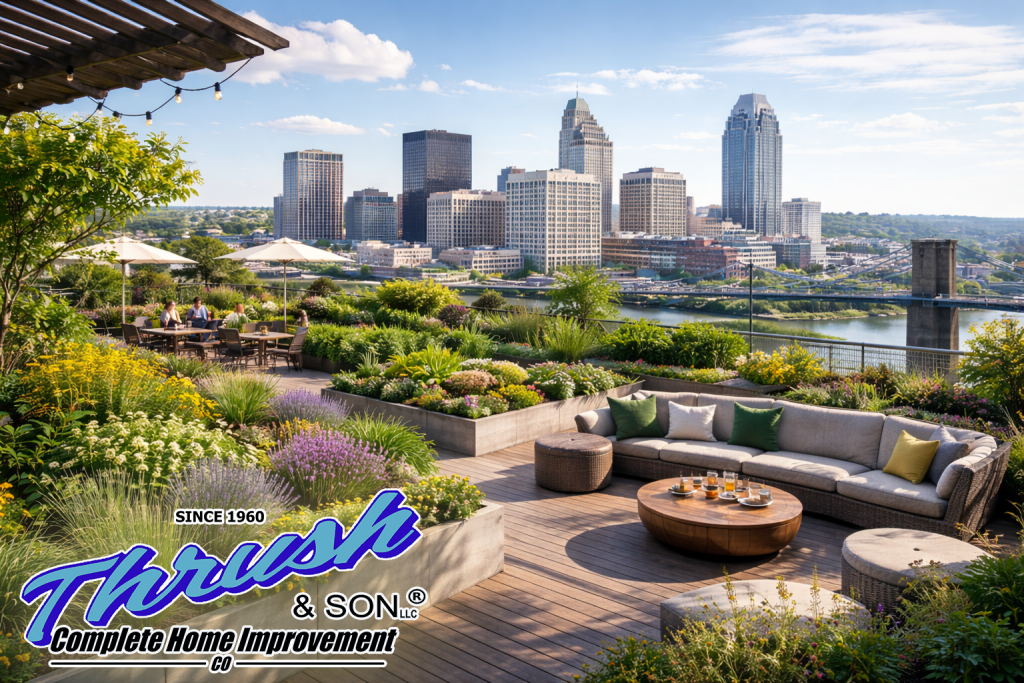
Sunny summer afternoon. Sources: DOE Energy Saver (conventional and cool roofs), U.S. EPA (green roofs). Bars are illustrative.
Water Use Designed Into the Building
Water is the resource everyone assumes will be there. A Green City builds conservation into both the plumbing and the property: efficient fixtures, rain captured where it falls, and landscaping chosen for the local climate so it doesn’t need constant irrigation or chemicals.
That second number is why water management is daily work for us. Every roof is a collection surface. Gutters sized for that volume, downspouts that discharge well away from the foundation, and drip edge that keeps runoff off the fascia turn a basement problem into water you can capture in a rain barrel for the garden.
Local Materials Built to Last Decades
Recycled and locally sourced materials cut raw extraction and trucking miles before the first nail is driven. In our experience, though, the greenest material is the one you don’t have to replace. The EPA estimates 600 million tons of construction and demolition debris were generated in the U.S. in 2018, and every roof torn off early adds to that pile.
That is why we steer homeowners toward complete systems instead of parts: shingles, underlayment, ventilation, and flashing from one manufacturer, installed to spec, so the warranty covers the whole roof. One roof that reaches its full service life leaves a smaller footprint than two cheaper ones. Our guide on how to choose a shingle covers what to compare.
The greenest roof is the one that doesn’t need replacing early.
A Recycling Program People Actually Use
Recycling only works when it is convenient and the rules are clear: collection that fits daily routines, consistent sorting guidelines, and buyers for the material on the other end. A Green City measures what it keeps out of the landfill, not just what it picks up at the curb.
The same discipline applies on a job site. Aluminum drip edge, copper flashing, and old gutters have real scrap value, so they get separated at tear-off instead of buried with the shingles. Here is how each Green City idea scales down to a single house.
| City-scale idea | What it looks like at home |
|---|---|
| Net-zero buildings | Attic insulation and air sealing before any panels go up |
| Green roofs | Reflective shingles and balanced attic ventilation |
| Water conservation | Gutters sized to the roof, downspouts carried away from the foundation, a rain barrel |
| Durable materials | A complete manufacturer roof system, installed to spec |
| Recycling | Scrap aluminum and copper kept separate at tear-off |
So, Is a Green City Within Reach?
In 2015 we asked whether a Green City was achievable in our lifetime. A decade later, pieces of it are already standing: tighter energy codes, cool roof requirements in several large cities, and planted rooftops on downtown buildings across the country. The rest gets built the way it always has, one house and one decision at a time.
What would you add to a Green City of the future? We read every comment, and the best ideas usually come from homeowners who live with these choices every day.
Start Your Green City Upgrade at the Roofline
Thrush & Son® has worked on Miami Valley homes since 1960. We’ll inspect your roof, attic, gutters, and windows, then show you in plain terms where your house is losing energy and water.
- GAF President’s Club Contractor
- Best of Dayton 2024 Winner · 2025 & 2026 Finalist
- BBB Accredited A+
Michelle, our AI assistant, answers 24/7
Office: Mon–Thu 9–4, Fri 9–2
