The Preseason Depth Chart for Your Home’s Exterior: 6 Checks Before Winter
Nobody in Columbus is nervous about Week 1.
The Buckeyes open September 5 against Ball State and nobody is losing sleep over it. The worry is Texas the following week. Oregon in November. Michigan on the 28th. The opener is a tune-up. What decides a season is work that got done — or didn't — when nobody was watching. Your house runs on the same calendar, which is why a home exterior checklist matters more in early September than it feels like it should.
It's going to be beautiful this weekend and your home is going to look fine. That's the trap. Houses don't fail in September. They fail in January, when an ice dam forms above a gutter that's held water since April, or in a March windstorm that finds the shingles that quietly let go in August. And in Ohio the window to fix it — contractor availability, temperatures warm enough for sealant to bond — is already closing.
We've been mixing sports and home improvement around here for years, so before you fire up the smoker, walk your house the way a coach walks a depth chart. Sixty-six years in the field have taught us that nearly every February emergency call traces back to something cheap and visible in September.
The Depth Chart
Every position on your home's roster, plus two bonuses for the tailgate.
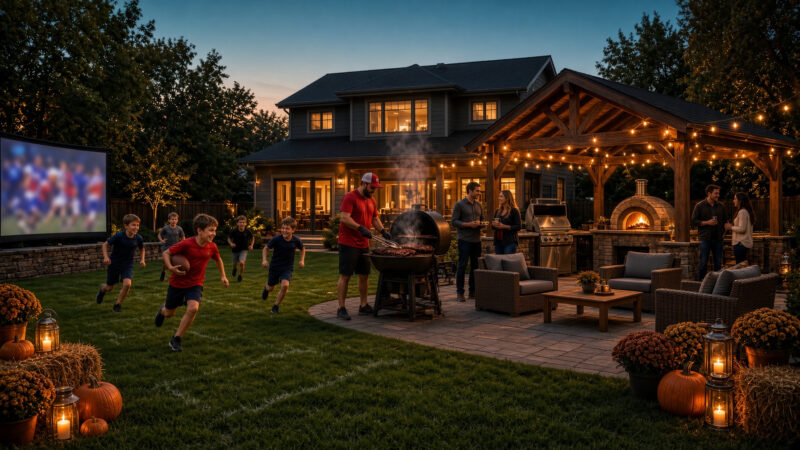
The Home Exterior Checklist, Written as a Depth Chart
The Offensive Line — Your Roof
Nobody talks about the line until it gives up a sack. Then it's all anyone talks about. A roof is identical — invisible for twenty years, then suddenly the most expensive conversation in the house.
From the ground, look for shingles that have lost their granules and gone slick and dark. The ridge should be straight as a yard marker; any sag means something structural is tired. Check the flashing where the roof meets a chimney or wall — that's where most leaks begin, not out in the open field. Then look at the boot around every vent pipe. Those collars dry-rot years before shingles do, and a failed one puts water into a ceiling. Our breakdown of the 5 roofing components that protect your home covers what sits under those shingles.
Special Teams — Gutters and Downspouts
Special teams quietly loses games. One blocked kick and the scoreboard doesn't care how well your offense played. Gutters are exactly that unglamorous — a fraction of a roof's cost, responsible for a startling share of the damage we get called out to see.
Here's the January version of a September problem. A clogged gutter holds water, water freezes, ice backs up under the shingle edge, and meltwater finds the soffit, then the wall, then your drywall. We wrote the full anatomy of that failure in our piece on ice damming, and it starts right here in September.
The Skill Positions — Siding, Windows and Doors
These are the highlight-reel guys — real value, and the first thing neighbors notice. They win you nothing if the line collapses.
Walk the perimeter. Push gently on siding that looks chalky, buckled, or loose — soft spots mean moisture is already getting in. Check the caulk around every window and door, especially the south and west sides where sun does the most damage. Then run the paper test: close a door on a dollar bill and pull. No drag means you're heating the backyard all winter. On siding, our rust bucket comparison explains why material choice outlives paint.
Strength and Conditioning — Your Attic
The least glamorous line on any home exterior checklist, and the single biggest reason a team is still standing in December. Nobody buys a ticket to watch it. It decides everything.
Most Midwest attics we open are underinsulated and badly ventilated, and the two failures compound. Poor ventilation lets heat build under the deck, melting snow unevenly and building the ice dam that ruins the gutter run below. Stick your head up there with a flashlight. If you can see the tops of the ceiling joists, you don't have enough insulation. Look for daylight at the soffit vents and dark staining on the sheathing — the fingerprint of a slow leak. The ENERGY STAR program publishes recommended insulation levels by climate zone, and it's a genuinely useful sanity check before anyone quotes you anything.
The Injury Report — 5 Checks You Can Make From the Driveway
This is the part of the home exterior checklist you can finish with a coffee in hand.
- Check 1Look at the ridge from the curb. Straight is healthy. Any dip or wave is a call.
- Check 2Find shingles that don't match their neighbors. Dark patches, curled edges, and missing tabs all read from the ground.
- Check 3Find the tiger stripes. Dark vertical streaks on the gutter face mean it's been overflowing a while.
- Check 4Check where the downspouts end. Dumping within two feet of the house means your foundation takes on water every storm.
- Check 5Check the fascia and soffit boards. Peeling paint, sagging, or a wasp entrance means rot has already started.
Five things, ten minutes. All clean and you can go enjoy your weekend.
The Two-Minute Drill — What to Do This Weekend
The injury report tells you what's wrong. This is the half of the home exterior checklist you act on before Monday.
Handle it yourself: clear the gutters and flush every downspout. Extend any downspout ending within two feet of the foundation. Re-caulk the two or three worst window joints. Clear debris from the roof valleys if you can reach them safely.
Put it on the calendar and call somebody: anything requiring you to walk the roof, any sag in the ridge, any staining on the attic sheathing, any siding that felt soft. Those aren't Saturday jobs. They're October jobs, and October fills fast — Ohio contractor calendars book out through the fall, and the good ones book first. Start with our proven tips on maintaining your home.
Bonus: Building the Gathering Space
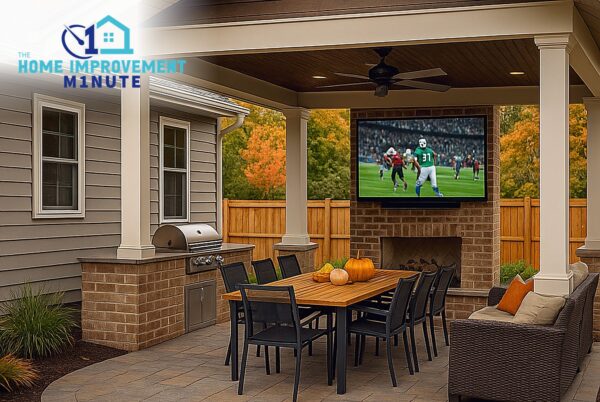
A home exterior checklist protects what you have. An outdoor kitchen is the other half — what you build so the house actually gets used.
We've watched a lot of Dayton-area families put money into backyards, and the ones still happy five years later made the same few decisions. They started with cover — a pergola, a roof extension, even an awning turns a patio from a June-through-August space into a March-through-November one. In Ohio that's the whole ballgame. They ran utilities before the concrete went down: a 20-amp circuit, a gas stub, a hose bib. Retrofitting later means breaking up what you just paid for. And they put the smoker downwind of the seating.
The mistake we see most is scale. People build a full outdoor kitchen with a sink they'll use twice and a refrigerator that dies in its third winter, when what they needed was counter space, a serious grill, shade, and light. Build it against a wall you're proud of, too — the siding behind that patio is the backdrop for fifteen years of family photos. Our guide to 7 outdoor space upgrades covers the rest.
Bonus: Corey's Sweet Mercy Ribs

You made it to the end, so here's the payoff — the rib recipe we actually cook, 3-2-1 rebuilt for baby backs. Serves 4 to 6. Six hours total, thirty minutes hands-on. Season the night before if you can.
Two things first. We wrap in butcher paper, not foil. Foil traps steam and braises the meat, which is why a two-hour foil wrap turns baby backs to mush. Paper breathes — you still get the tenderizing, but the bark survives. And we score the membrane instead of pulling it. Peeling is fine advice, but hard scoring gets you there without the wrestling match.
What You'll Need
Ribs and binder: 2 racks baby backs, Bertman Original Ball Park Mustard. The spritz: ½ cup apple juice and ¼ cup cider vinegar in a spray bottle, open-smoke phase only.
The rub: ½ cup dark brown sugar, 2 tbsp cinnamon, 2 tbsp kosher salt, 1 tbsp smoked paprika, 1 tbsp coarse black pepper, 1 tbsp cayenne, 2 tsp garlic powder. Salt assumes Diamond Crystal — with Morton's, cut to a heaping tablespoon. And yes, that's a lot of cinnamon. It looks wrong in the bowl and smells like a pie. Trust it. Against that much brown sugar and cayenne it lands near Mexican chocolate, a better place for pork than you'd think. Don't like heat? Cayenne to a teaspoon, leave the rest alone.
The wrap, per rack: Parkay Squeeze (liberally), 2 tbsp dark brown sugar, 2 tbsp honey, a spritz of apple juice, a dusting of rub. The glaze: 1 cup thick BBQ sauce, 1 tbsp cider vinegar, 1 tbsp reserved liquid from the paper, 1 tsp hot sauce — optional, but do it.
Prep
Flip the racks bone-side up and score the membrane hard — diagonal cuts an inch apart, then again the other way. Don't be timid. You want it opened up so smoke and rub get underneath and it renders instead of setting like leather. Cut the membrane, not the meat. Trim loose flaps and heavy fat.
Now the Bertman's, generously, both sides, worked into the score marks. That brown stadium mustard has real horseradish bite, and unlike yellow mustard it doesn't disappear in the cook — it's doing flavor work, not just holding rub. Season heavily, pressing the rub in. Rest 30 minutes; better, four to twelve hours ahead, refrigerated uncovered.
Phase One: Smoke, 3 Hours
Smoker at 225°F. For wood, two parts cherry or apple to one part hickory — color and sweetness from the fruitwood, just enough hickory to taste like barbecue without steamrolling the pork. Ribs meat-side up, and leave them alone for ninety minutes. No peeking, no spritzing.
From ninety minutes on, spritz every 30 to 45 minutes. The surface should look damp, not rinsed — you're keeping the bark pliable, not washing it. At three hours you want deep mahogany and a set rub. If the seasoning smears, give it fifteen minutes.
Phase Two: Wrap in Paper, 2 Hours
Tear two long sheets of butcher paper per rack — you're double-wrapping, and you'll want the extra layer. Onto the paper: a liberal run of Parkay, the brown sugar, the honey, a light dusting of rub. Lay the ribs meat-side down into it, spritz with plain apple juice (no vinegar — this stage is sweet), fold tight, roll the seam under, back on at 225°F.
Two hours. Because it's paper you aren't fighting the clock the way you would in a sealed pouch — the wrap breathes, the bark holds, and the meat gets there without going to pieces. Unwrap over a sheet pan; the paper will be saturated and will tear right where you don't want it.
Phase Three: Glaze, 45 Minutes
Save a spoonful of liquid off the pan, then ribs back on bone-side down at 250°F. Stir the vinegar, reserved liquid, and hot sauce into your sauce. That tablespoon of vinegar is load-bearing — without something sharp at the end, the rack reads as dessert. Brush one thin coat, wait fifteen minutes, second thin coat, spritz conservatively, then let it ride until the sauce is glossy and tacky rather than wet. Pile it on and you'll get a scorched crust instead of a lacquer.
How You Know They're Done
Three checks, all of them. Bend test: lift the rack a third of the way in with tongs — it should bend deeply and the bark should crack. Toothpick test: it slides between the bones with no resistance. Bone twist: turn a middle bone gently; it should move without falling out, unless falling out is what you're after.
Rest fifteen minutes, flip bone-side up, and slice between the bones. Leftovers keep four days — the USDA Food Safety and Inspection Service has full storage guidance. Reheat wrapped in foil at 275°F for twenty minutes. This is the one time foil is right, because now you want the steam.
Smoky and sticky, sweet up front, cinnamon underneath, cayenne arriving late to keep it from being dessert. Sweet mercy.
The Takeaway Worth Sharing
Your house never loses in Week 1. It loses in January, because of what nobody bothered to look at in September.
Send this to the neighbor whose gutters you've been staring at all summer.
Get It On the Calendar Before Kickoff
Thrush & Son® — trusted exterior pros since 1960.
Proudly serving Dayton and the Miami Valley with roofing, siding, windows, and doors. If your home exterior checklist turned up something you'd rather not guess about, we'll walk your home, document what we find honestly, and tell you straight whether it needs attention now or can wait until spring. Free, no pressure — and nobody knocking on your door to sell you anything.
Schedule in DaytonView All ServicesOr call us direct: (937) 833-5136 | 115 Jefferson St., Brookville, OH 45309
Further Reading
Official sources: NWS Wilmington for local first-frost dates and seasonal outlooks, and ENERGY STAR for insulation and window efficiency standards.
Stay Connected with the Thrush & Son® Family