
Your House Breathes Through Its Roof: Choosing the Right Vents
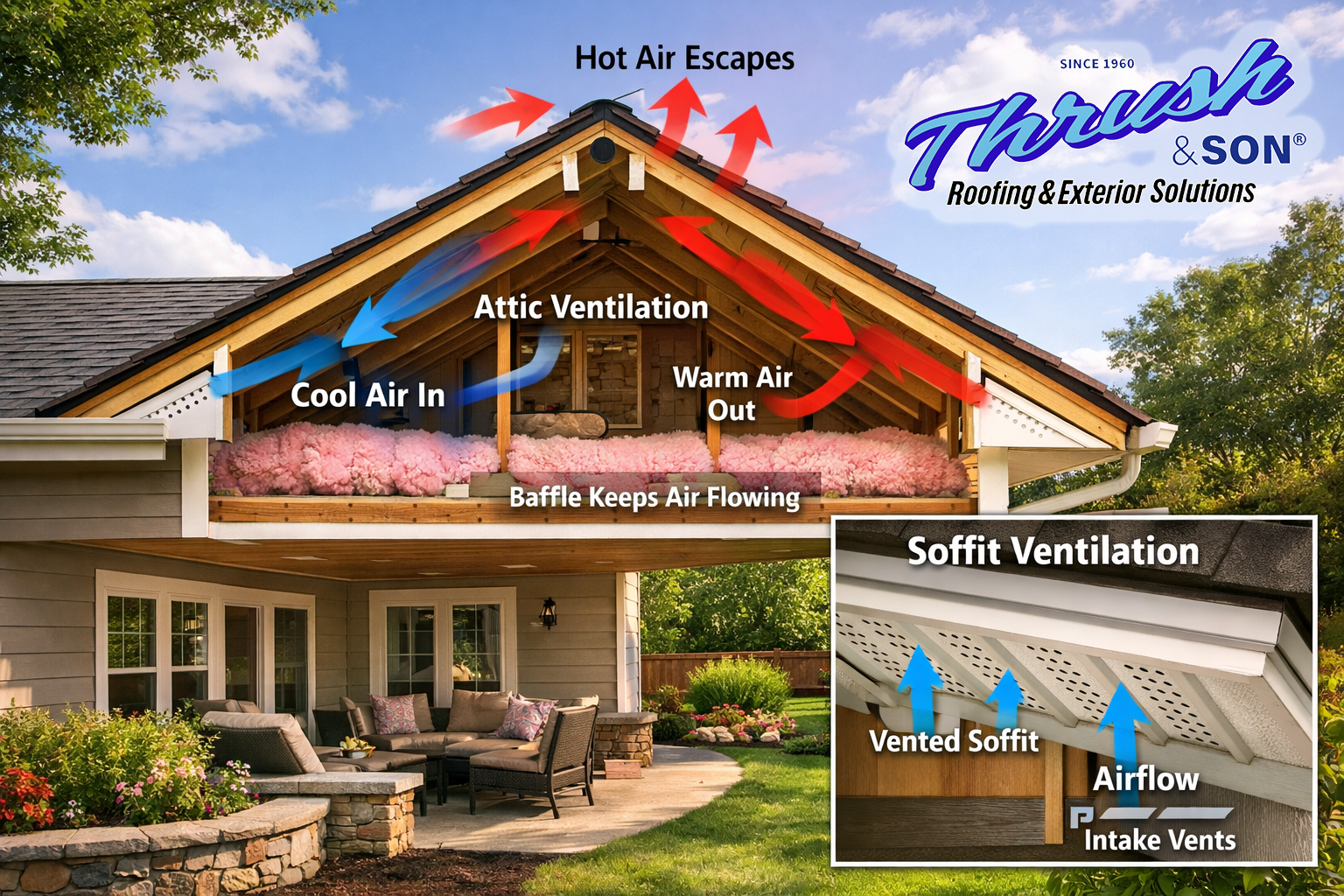
Attic ventilation options come down to one rhythm: the attic inhales cool air low at the eaves and exhales warm, moist air high at the peak. Pick the wrong vents, or the wrong mix, and the roof holds its breath.
Below you’ll find every common vent in one lineup, a matcher for your roof shape, and the mistake that quietly ruins good vents. For how much ventilation an attic needs, see our attic ventilation guide.
Eight Attic Ventilation Options, Side by Side
Every vent is either an inhale or an exhale. Filter the lineup to compare attic ventilation options by job and by moving parts.
Ridge vent
Runs along the peak under the ridge cap. Continuous, low-profile, and the exhaust we use on most roofs with enough ridge length.
Continuous soffit vent
A vented strip along the underside of the overhang. Spreads intake evenly along the whole eave.
Individual soffit vents
Rectangular or round vents cut into solid soffit. They work, but they leave gaps in intake between vents.
Roof-edge intake vent
Intake built in at the bottom of the roof for houses with little or no overhang to put a soffit vent in.
Static box vents
Low-profile boxes near the top of the roof. Simple and passive; they need several, spaced evenly, all of the same type.
Gable vents
Louvered openings in the end walls. Air tends to move across the top of the attic rather than up from the soffits.
Turbine vents
Wind-driven spinning heads. Moving parts mean bearings to wear out and a bit of noise.
Powered attic fans
Electric fans that pull air out. They can also pull conditioned air from the house through ceiling gaps.
Of all the attic ventilation options, most Miami Valley homes we work on end up with the same pairing: continuous soffit intake and a ridge vent. It’s quiet, has no moving parts, and pulls air across the whole underside of the roof. Our soffit page shows the intake side up close. The airflow and upkeep bars are our crews’ rule-of-thumb ratings, not lab measurements.
Match Attic Ventilation Options to Your Roof Shape
The right attic ventilation options depend on the shape of the roof. Pick the one that looks most like yours.
Continuous soffit intake + ridge vent
The classic pairing. Air comes in low along every eave and leaves high along the whole peak, sweeping the full underside of the roof deck.
Soffit intake + one exhaust type
Hip roofs have lots of eave but little ridge. Use ridge vent where the ridges allow it, or evenly spaced static vents near the top, but pick one exhaust type, not both.
Roof-edge intake + ridge vent
With no soffit to vent, intake moves to the roof edge. The exhaust stays at the ridge so air still travels the whole slope.
Air sealing first, then a custom plan
Knee walls and sloped ceilings change where the air can go. These need air sealing and a plan for each section, so we look in person.
The Mistake That Ruins Good Attic Ventilation Options
Two kinds of exhaust on one attic sounds like double the airflow. It isn’t. The Asphalt Roofing Manufacturers Association warns that combining different exhaust vents over a common attic may cause short-circuiting, and vent makers say the same in their instructions (Roofing magazine has the details).
Balanced: one exhaust type
Air enters at both soffits and travels up the full slope to the ridge, washing heat and moisture off the underside of the deck.
Short-circuited: two exhaust types
The ridge vent pulls air in through the nearby box vent instead of the soffits. The lower attic goes stale, and weather can enter through the second vent.
Why Powered Fans Aren’t Our First Choice
Powered fans look like the strongest of the attic ventilation options, but strength isn’t the goal. The Building America Solution Center says passive ventilation is generally recommended over attic fans.
A fan creates negative pressure that can pull conditioned air out of the living space through ceiling gaps, and it may cause some combustion appliances to backdraft.
ENERGY STAR adds that if soffit vents are blocked and the attic isn’t sealed from the house, an attic fan will pull cool air up out of the house. Air sealing and clear intake come first; see cool home exterior for summer heat.
Intake Is the Half Everyone Forgets
Three of the eight attic ventilation options in the lineup are intake vents, yet exhaust gets the attention because you can see it from the street. But an exhale needs an inhale. If the soffits are solid, painted shut, or packed with insulation, no ridge vent can do its job.
ENERGY STAR calls blocking airflow at the eaves the most common mistake homeowners make when insulating. Rafter vents, also called baffles, hold the insulation back so air can flow. In winter, that cold, moving air keeps the roof deck cold and helps prevent ice dams; see ice dam prevention and ice damage.


Ventilation Designed With the Roof
Wilbur Thrush founded Thrush & Son in 1960. W. Allen Thrush owns the company today, and Corey Thrush is the third generation. More than 31,000 Miami Valley homeowners have trusted us, from our Brookville headquarters and offices in Troy and Lebanon.
On every roof replacement we check intake and exhaust and choose attic ventilation options that fit the house, as part of a complete GAF system from a President’s Club Contractor. See every layer in parts of a roof and roofing components, our roofing services, the project gallery, and homeowner reviews.
Attic Ventilation Options: Your Questions, Answered
What homeowners ask us most when they compare attic ventilation options.
What are the main attic ventilation options?
The attic ventilation options split into intake vents low on the roof (continuous soffit, individual soffit, or roof-edge intake) and exhaust vents high on the roof (ridge vents, static box vents, gable vents, turbines, or powered fans). A working system always pairs intake with exhaust.
Can I mix a ridge vent with box vents or a power fan?
It’s generally not recommended. Ventilation manufacturers and the Asphalt Roofing Manufacturers Association advise against combining different exhaust types over a shared attic, because the airflow can short-circuit between them. Roofing magazine explains why.
Are powered attic fans a good idea?
Usually not as a first choice. The Building America Solution Center says passive ventilation is generally recommended over attic fans, because a fan can pull conditioned air from the house and may cause some combustion appliances to backdraft.
What’s the most common ventilation mistake?
Blocked intake. ENERGY STAR calls blocking airflow at the eaves the most common mistake homeowners make when insulating. Rafter vents, also called baffles, keep the soffit vents clear.
How much attic ventilation do I need?
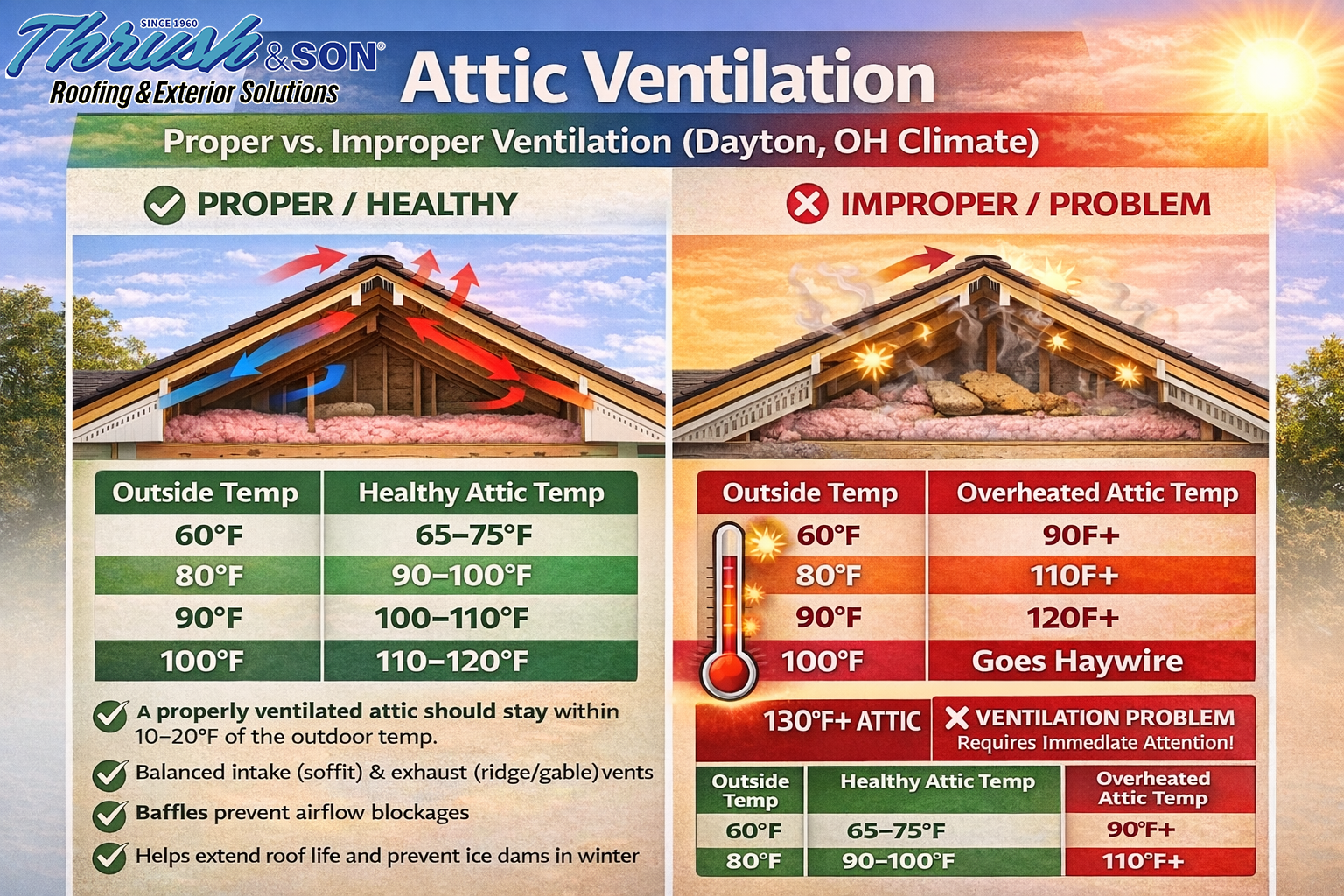
Codes set a minimum net vent area based on attic floor area, commonly 1:150, or 1:300 when certain conditions are met, split between intake and exhaust. Our attic ventilation guide has a calculator.
Can ventilation be changed without a new roof?
Some parts, like soffit vents and baffles, can be added any time. Ridge vents and other roof vents are easiest to change during a reroof, when the shingles are already coming off.
Let Your Roof Breathe Again
We’ll check your attic’s intake and exhaust, show you photos of what we find, and recommend the attic ventilation options that fit your roof, with a written plan and no pressure. Ask about financing.
Call 937-833-5136 · Office: Mon–Thu 9–4, Fri 9–2 · Michelle, our AI assistant, answers 24/7
