
What Your Walls Look Like on a Thermal Camera
Energy efficient siding is about the part of the wall you never see. Point a thermal camera at most older homes on a January night and the walls glow in stripes, one stripe for every stud, where heat walks straight out of the house.
Below, switch our thermal camera between hollow and insulated vinyl, see what the numbers say, try 18 insulated siding colors on a real home, and build the whole-wall plan that makes energy efficient siding pay off.

Energy Efficient Siding Through a Thermal Camera
This is an illustration of a wall section with a window, the way an infrared camera sees it: from outside on a winter night, and from inside on a summer afternoon. Switch the siding and the season to see where heat moves.
Hollow vinyl
Standard panels hang in front of the sheathing. Every stud behind them is a direct path for heat, out in winter and in during summer, so the wall shows a bright stripe at each stud.
Insulated vinyl
Foam fused to the back of each panel runs continuously over the studs, so the wall reads as one even surface instead of a row of stripes, whatever the season.
The window still glows either way, because glass is the weakest part of most walls. That’s why energy efficient siding pays off most alongside efficient replacement windows. The U.S. Department of Energy notes that insulated siding reduces thermal bridging and provides continuous insulation by covering the studs.
What Makes Energy Efficient Siding Different
Three figures explain why the foam matters, from the Polymeric Exterior Products Association and ENERGY STAR.
Siding is one piece of the savings picture. ENERGY STAR estimates homeowners save an average of 15% on heating and cooling costs by air sealing and adding insulation in attics, crawl spaces, and basements. Energy efficient siding adds to that by insulating the walls, the one surface those upgrades don’t touch. For how R-values compare with window ratings, see R-Value vs. U-Factor.
Hollow Vinyl vs. Insulated Vinyl
Both are vinyl, both come in dozens of colors, and both skip the paint. Here’s where they part ways.
| Hollow vinyl | Insulated vinyl | |
|---|---|---|
| Behind the panel | An air gap against the wall | Rigid foam fused to the panel |
| Over the studs | No added insulation | A continuous blanket over every stud |
| Feel and look | Can wave or flex on uneven walls | Stiffer, flatter, more solid to the touch |
| Impact | Can crack or dent when hit | Foam backing supports the face |
| Sound | Panels can rattle in wind | Quieter, more solid wall |
| Cost | Lower upfront | Higher upfront, more performance |
Summer matters too. On a July afternoon the sun bakes the south and west walls, and studs carry that heat inward the same way they carry winter heat out. The foam layer slows it in both directions, which is why rooms on the sunny side of the house often feel the biggest change after a siding project.
Already planning a new roof or windows? Doing the walls in the same season lets one crew flash every joint between them. See how windows pay back in Top 5 Reasons to Invest, and how attic insulation choices compare in Fiberglass vs. Spray Foam and Cellulose Insulation.
See Energy Efficient Siding in 18 Colors
This home is wrapped in CertainTeed CedarBoards insulated siding. Tap a color to recolor the siding; the roof, stone, and trim stay exactly as they are.
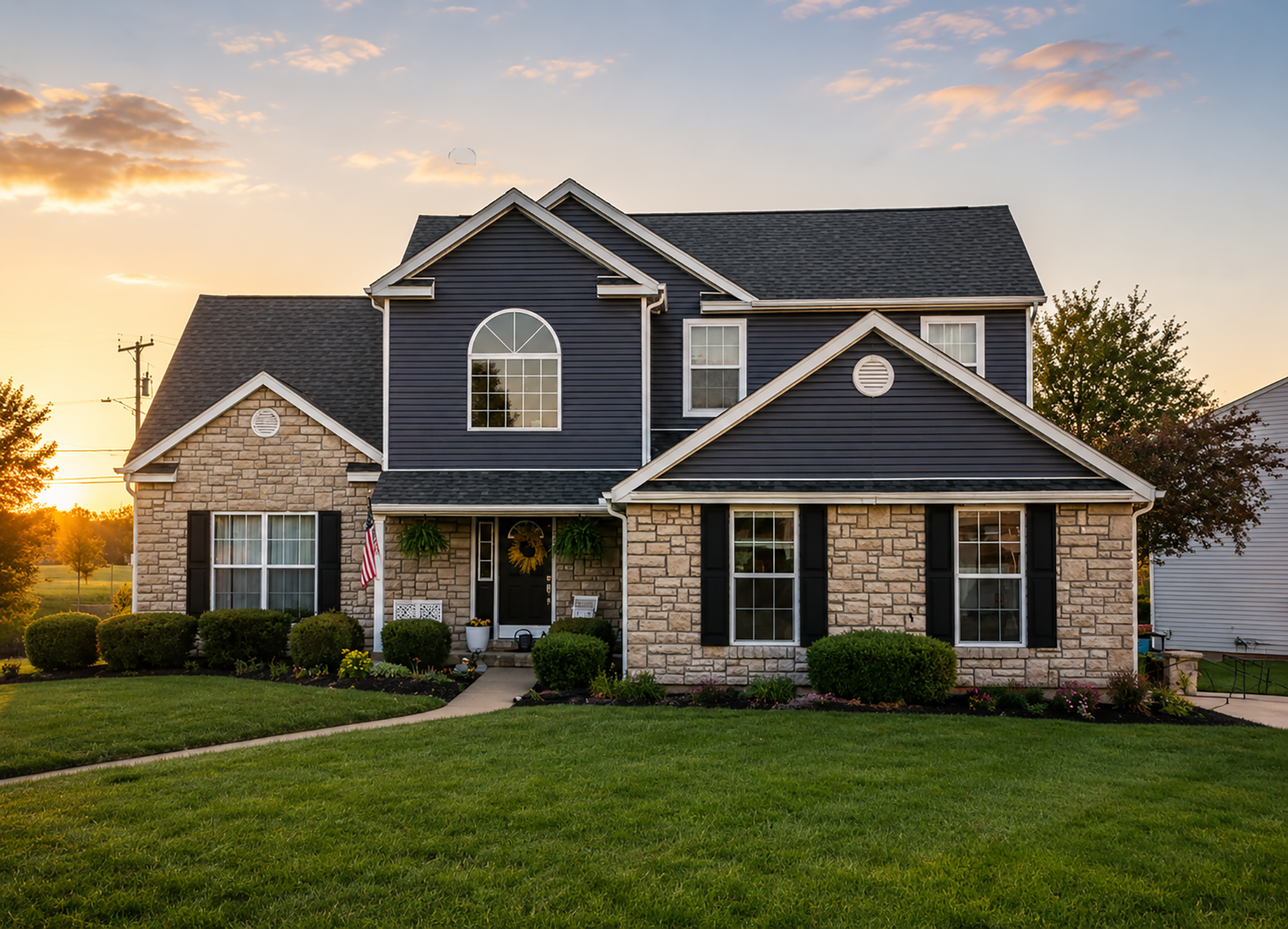
Colors are approximate. We bring full-size samples to every estimate.
CedarBoards bonds foam to the back of each panel, which adds insulation and stiffens the wall so it lies straighter. Compare it on our CertainTeed insulated siding page and our insulated vinyl siding service page, or read Insulated Siding for the full story.
5 Steps That Make Energy Efficient Siding Pay Off
Energy efficient siding is one layer of a system. Done in this order, each step makes the next one work harder.
- 1
Air sealing first
Gaps around outlets, top plates, and the attic hatch leak more heat than the siding can stop. Seal them before anything else.
- 2
Attic insulation
Heat rises, so the attic is usually the cheapest win. See how ventilation and insulation work together in Is Attic Ventilation Important?.
- 3
Weather barrier and flashing
A house wrap lapped top over bottom and flashing at every opening keep the new wall dry, which keeps insulation working. More in Prevent Water Damage.
- 4
Insulated siding outside
Foam-backed panels wrap the studs in a continuous layer, cutting the thermal bridges no cavity insulation can reach.
- 5
Efficient windows
Windows are the weakest part of most walls. Pair new siding with replacement windows and the wall finally performs as one system.

What Energy Efficient Siding Won’t Do
We’d rather set expectations now than after the install:
- It won’t replace insulation inside the wall cavities. It adds to it.
- It won’t fix air leaks around windows, outlets, or the attic. Those need sealing.
- It won’t deliver the same savings on every house. Older homes with thin wall insulation gain the most.
- It won’t soundproof a house, though many owners notice a quieter interior.
What it does do: cover every stud in a continuous blanket, stiffen the panels against dents and wind, and give you a straighter-looking wall for decades. Read about toughness in Vinyl Siding Durability and plan the whole project in Dayton Ohio Siding Replacement.
The Family Behind Your Energy Efficient Siding
Wilbur Thrush founded Thrush & Son in 1960. W. Allen Thrush owns the company today, and Corey Thrush is the third generation. More than 31,000 Miami Valley homeowners have trusted us, from our Brookville headquarters and offices in Troy and Lebanon.
Our crews strip the old siding, check the sheathing, wrap and flash the wall, and hang every panel, so the insulation goes on a sound, dry wall. See the project gallery and read homeowner reviews.

Energy Efficient Siding Questions, Answered
What Miami Valley homeowners ask us before they insulate the outside of the house.
What is the most energy efficient siding?
Among the products we install, insulated vinyl siding adds the most insulation to the wall. Industry testing puts insulated vinyl at about R-2 and up to R-3 or R-4, while many siding materials are below R-1, according to the Polymeric Exterior Products Association.
How much will energy efficient siding save on my bills?
It depends on the house: how well the walls are insulated now, how leaky it is, and your heating fuel. Siding helps most on older homes with thin wall insulation and does the most good alongside air sealing and attic insulation.
Does insulated siding replace wall insulation?
No. It adds a continuous layer outside the studs, but the wall cavities still need insulation. The two work together.
Does energy efficient siding reduce outside noise?
Many homeowners notice a quieter house, because the foam backing dampens sound and keeps panels from rattling. It isn’t soundproofing, but it helps.
Can energy efficient siding go over my old siding?
Sometimes it can, but we usually remove the old siding first. That lets us check the sheathing for rot, install a proper weather barrier and flashing, and hang the new panels on a flat, sound wall.
Will thicker insulated panels change my trim?
Insulated panels stand out a little farther from the wall, so window and door trim, J-channel, and corners are sized to match. We plan that detail before ordering so everything finishes flush and clean.
Is insulated siding stronger than regular vinyl?
The foam backing supports the panel, so it lies flatter and resists dents and wind better than hollow vinyl.
Find Out What Your Walls Are Leaking
We’ll look at your siding, windows, and attic together, tell you where energy efficient siding fits and where another upgrade comes first, and give you a written quote with no pressure. Ask about financing, and see more on our vinyl siding page.
Call 937-833-5136 · Office: Mon–Thu 9–4, Fri 9–2 · Michelle, our AI assistant, answers 24/7
Follow Along
Siding projects, crew life, and BooBoo by the heater vent. Meet the family here.
