
Prevent Leaves From Clogging Your Gutters: Follow One Leaf From Branch to Downspout
To prevent leaves from clogging your gutters, you have to think like a leaf. It falls from a branch, lands on the roof, slides into the gutter, rides into the downspout, and finally ends up on the ground beside your foundation. Every stop along that path is a place to stop it.
Gutters aren’t the most exciting part of a home, but they protect everything under them: siding, fascia, landscaping, the foundation, and the roof edge itself. Across the Miami Valley, falling leaves are the most common reason they stop working. The good news is that a few smart habits and the right upgrades handle most of it.
Follow the Leaf From Branch to Ground
Pick a stop to see what one leaf does there and how to prevent leaves from causing trouble at that point.
The branch: Every leaf starts here
Branches that hang over the roof drop leaves, twigs, seed pods, and acorns straight onto the shingles. Wind and storms shake loose even more.
How to prevent leaves here- Prune limbs back so none hang over the roof.
- Have a certified arborist handle large limbs near the house.
- Watch for trees that suddenly shed more than usual.
The roof: Leaves pile up in the valleys
Leaves settle where two roof slopes meet and behind chimneys. Wet mats hold moisture against the shingles, then wash into the gutters in the next rain.
How to prevent leaves here- Look at the roof valleys from the ground after peak leaf drop.
- Clear heavy piles before they get soaked and matted.
- Leave climbing to a crew with the right gear.
The gutter: Wet leaves mat over the outlet
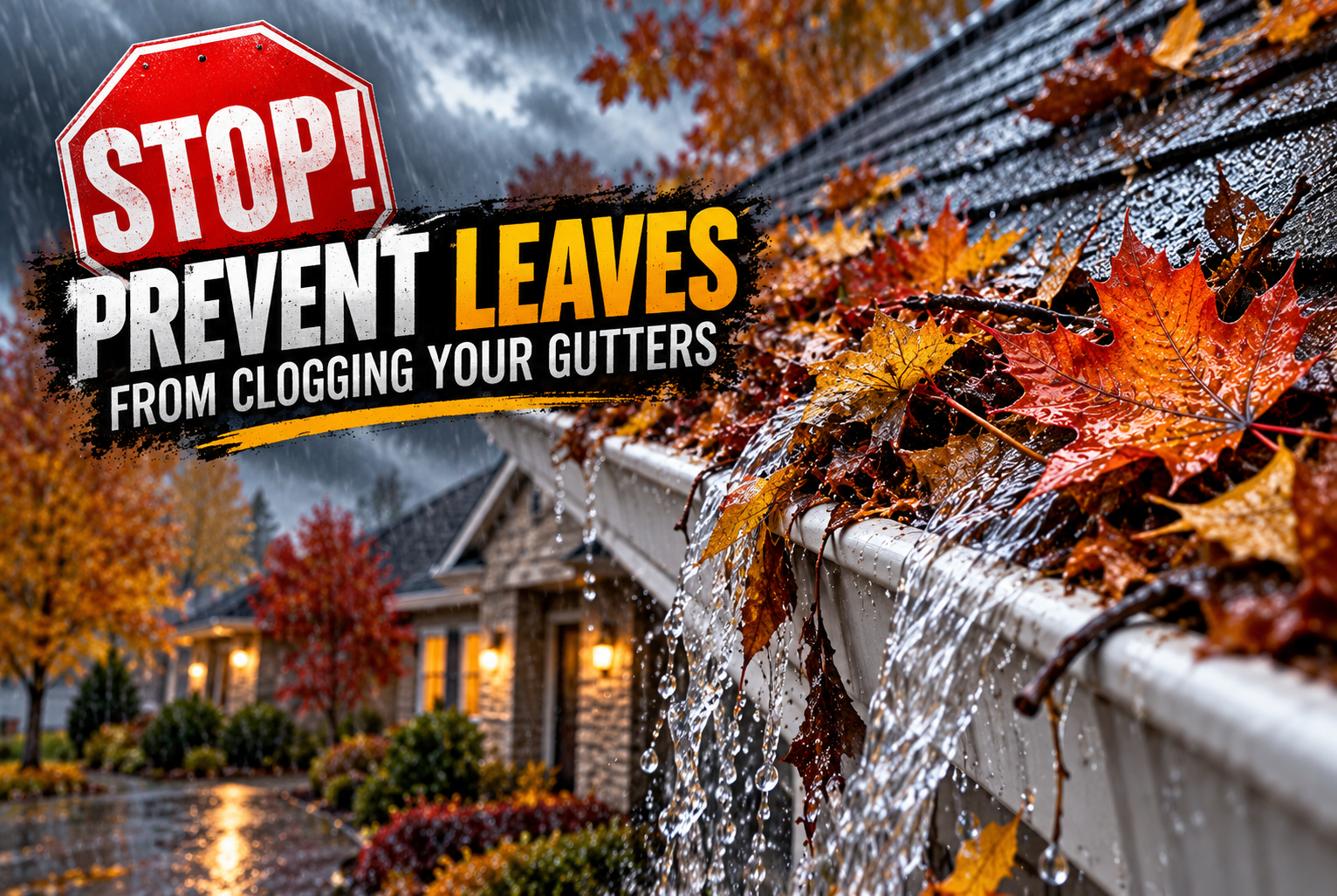
Once leaves reach the gutter, they slide toward the outlet and form a soggy plug. Water rises behind it and spills over the front edge.
How to prevent leaves here- Clean in late spring and again after the leaves have fully dropped.
- Add a rigid gutter guard that keeps leaves out of the trough.
- Make sure every run slopes toward its outlet.
The downspout: Where most clogs actually form
Every drop from the roof funnels into this narrow pipe. Leaves jam in the elbows, and the whole gutter backs up above them.
How to prevent leaves here- Add a strainer or leaf screen at the top of each downspout.
- Run a garden hose down each spout to check the flow.
- Upgrade to larger 3×4 downspouts on heavy-leaf runs.
The ground: The water still has to go somewhere
Leaves pile around splash blocks and extensions, and buried drains can fill with sludge. Water then pools right beside the foundation.
How to prevent leaves here- Keep downspout extensions and splash blocks clear.
- Rake leaves away from the foundation line.
- Send water to lawns or beds where it can soak in, as the EPA suggests.
Why One Clog Becomes Five Problems
When a gutter clogs, water stops flowing away from the house. It spills over the front edge, soaks the fascia, streaks the siding, and pools along the foundation. Left alone, that can mean basement leaks, wood rot, mold, ice buildup in winter, and early wear at the roof edge.
That’s why it pays to prevent leaves from building up in the first place rather than reacting to the mess. If you want to know which trees around your home cause the most trouble, see Clogging Your Gutters. For guard options and timing, read our guide to fall gutter protection.

How Big Is Your Leaf Load?
Check everything that’s true at your house. We’ll count it up and suggest how much it takes to prevent leaves from clogging your gutters.
Two cleanings a year will usually keep you clear: once in late spring after the seed pods fall, and once in late fall after the last leaves drop.
Prune any overhanging limbs, add strainers to the downspouts, and check the gutters right after peak leaf drop. One missed cleaning can mean an overflow.
This is where gutter guards pay for themselves. A rigid micromesh guard like WaterLock® Pro keeps leaves on top and water moving, so you’re not on a ladder every few weeks.
5 Simple Ways to Prevent Leaves From Clogging
No single step does it all. Combine these and you’ll prevent leaves from turning into overflow, leaks, and ladder weekends.
Prune overhanging branches
Start at the source. Trees directly above the roofline drop leaves, twigs, and seed pods all year, and storms shake loose even more. Cutting limbs back from the roof cuts the leaf load at the gutter. Leave big limbs near the house to a certified arborist.
Clean at the right times
Timing beats frequency when you want to prevent leaves from piling up. For homes around deciduous trees, clean once in late spring after seed pods and blossoms fall, then again in late fall after the leaves have fully dropped. Cleaning in mid-October just means doing it twice.
Install a rigid gutter guard
Guards are the long-term way to prevent leaves from reaching the trough at all. A rigid micromesh panel holds its shape under wet leaves and snow, lets rain through, and lets dry leaves blow off the top.
Protect the downspouts
All roof water funnels into the downspout, so that’s where clogs get serious. Add strainers at the outlets, keep extensions clear, and follow DOE’s Building America guidance to discharge water at least 5 feet from the foundation.
Watch for stressed or sick trees
A tree that suddenly drops far more leaves or limbs than usual may be stressed or diseased. A quick look each season helps prevent leaves and limbs from surprising you, before it buries your gutters outside of fall or drops a limb on the roof.
Want the full fall routine? Our Mind in the Gutter checklist and home exterior checklist cover the rest of the house, and Maintenance Is a Must explains why it all adds up.
When It’s Time for a Guard
If you’re cleaning more than twice a year and still seeing overflow, a guard is the simplest way to prevent leaves from ever reaching the trough. We install WaterLock® Pro, a stainless steel micromesh panel in a formed aluminum frame, on seamless gutters we install.
Not sure which style fits? Our breakdown of gutter protection systems compares them, and our gutter services page covers new seamless gutters if yours are sagging or leaking.

Before any guard goes on, our team checks the pitch of every run, tightens loose hangers, and flushes each downspout. A guard on a gutter that already sags or leaks only hides the problem, so that groundwork comes first on every job.
We also look at the fascia behind the gutter. Years of overflow can soften that board, and it needs to be solid before anything gets fastened to it.
Questions That Pour In Every Fall
What homeowners ask us most about how to prevent leaves from clogging their gutters.
How often should I clean my gutters if I have a lot of trees?
At least twice a year: late spring and late fall. Under heavy oak, maple, or pine cover, add a check right after peak leaf drop. If that still isn’t enough, a gutter guard is the better answer than more ladder trips.
Do gutter guards stop every leaf?
They stop leaves from getting into the trough, which is what matters. Some leaves will rest on top of the guard, and most blow off once they dry. Under pines, plan on brushing the surface now and then.
Why do my downspouts clog when the gutters look clear?
Small debris like seed pods, twigs, and shingle grit slips past and jams in the downspout elbows. A strainer at the outlet catches it where you can reach it, and a hose test shows whether water flows freely.
Do I need to cut down the tree to prevent leaves from clogging my gutters?
Usually not. Pruning limbs back from the roof plus a quality guard handles most homes. Removal is a call for a certified arborist, especially if the tree is stressed, diseased, or leaning toward the house.
Is it safe to clean gutters myself?
It can be risky. The CDC’s ladder safety guidance exists because falls from ladders are a leading cause of injuries. Wet leaves, cold hands, and early dark make fall the worst time to climb.
Can leaves in my gutters cause ice dams?
They make winter worse. Packed leaves hold water that freezes at the roof edge and blocks meltwater. Ice dams start with attic heat, which our ice dam prevention guide covers, but clear gutters give the melt somewhere to go.
Every Link in the Chain
A rain chain only works when every cup holds. Since 1960, Thrush & Son® has been family-owned and built on craftsmanship, consistency, and long-term homeowner trust, from our headquarters in Brookville and offices in Troy and Lebanon.
See finished work in our project gallery.
Get Ahead of the Next Storm
Leaves don’t wait for a dry week, and neither does rain. We’ll look at your trees, roof valleys, gutters, and downspouts, then show you the simplest way to prevent leaves from clogging any of them. Written quotes, with financing available. Call 937-833-5136.
Michelle, our AI assistant, answers 24/7 · Office: Mon–Thu 9–4:30, Fri 9–2
Stay Connected, Rain or Shine
Follow the Thrush family and BooBoo for seasonal tips and finished projects.
