
Before You Buy Replacement Windows: 7 Ways to Protect Your Home and Budget
Replacement windows are one of the few upgrades you feel every day: in a warmer couch in January, a quieter bedroom, and a lower bill. They are also one of the easiest to get wrong, because the parts that decide how a window performs are the parts a sales brochure skips.
I grew up in this industry, sitting at kitchen tables with homeowners making this exact decision. These seven secrets are what I’d want my own family to know before signing. Use them to compare quotes, and you’ll know which replacement windows are built for your house and which are built for the price sheet.

Why Replacement Windows Pay You Back
7 Buying Secrets for Replacement Windows
Read the NFRC Label Before the Brochure
Every certified window carries a label from the National Fenestration Rating Council. Two numbers matter most. U-factor is how fast heat escapes; lower is better. SHGC is how much of the sun’s heat gets through, and the right number depends on where you live.
In most of the Miami Valley, ENERGY STAR wants low U-factor with enough solar gain to help in winter. Our breakdown of ENERGY STAR 7.0 windows shows why your county decides the glass. If a salesperson can’t point to the label on the exact replacement windows being quoted, the numbers in the brochure don’t mean much.
Pick the Frame for Ohio’s Temperature Swing
Ohio can swing 100 degrees between February and August, and frames move with it. Vinyl is the most common choice for replacement windows here for good reason: it insulates well, never needs paint, and quality units use fusion-welded corners and multi-chamber profiles that stay square. Fiberglass expands at nearly the same rate as glass and is the strongest option for large or dark-colored units. Wood is beautiful inside and the most maintenance outside.
Ask what’s inside the frame, not just what color it comes in. Chamber count, corner construction, and reinforcement in the meeting rail are what separate a 30-year window from a 10-year one.
Match the Style to the Room
The right style of replacement windows depends on what the room does. Pick a room to see what we usually recommend and why.
A crank handle reaches across a counter and deep sink far more easily than lifting a sash. Casements also catch side breezes and seal tightly when closed.
Bedroom windows double as emergency exits, so code sets a minimum clear opening (5.7 sq ft for most upper-floor bedrooms). Switching styles can shrink that opening, so we measure it before we order.
A fixed picture unit gives the most glass and the tightest seal. Casements or double-hungs on each side handle fresh air.
An awning sash hinges at the top, so it can stay cracked open for ventilation in light rain. Obscure glass gives privacy without blinds that trap moisture.
Low wells and tight openings suit a slider or a bottom-hinged hopper. If the space is, or will be, a bedroom, the egress rules above apply.
Both sashes tilt into the room, so the outside glass gets cleaned from inside. No ladder against the siding.
For a closer look at one of the most versatile styles, see our guide to casement windows.
Installation Is Half the Window
Most drafts and leaks we’re called to look at are installation problems, not product problems: a missing sill pan, expanding foam that bowed the frame, or flashing that was never tied into the wall. The best replacement windows on the market will still underperform if they’re set out of square.
The first decision is the method. An insert goes inside the existing frame; a full-frame install takes the opening back to the studs. Neither is always right, and a contractor who only offers one is telling you about their crew, not your house.
| Insert | Full-frame | |
|---|---|---|
| What stays | Existing frame, interior trim, exterior casing | Nothing. Opened to the rough opening |
| Best when | The old frame is square, dry, and solid | Frame rot, water stains, or a style or size change |
| Flashing | Relies on the existing frame’s weatherproofing | New flashing and sill protection tied into the wall |
| Glass area | Slightly smaller, the new frame sits inside the old | Full opening restored |
One more rule worth knowing: if your home was built before 1978, the contractor disturbing old painted trim must follow the EPA’s lead-safe work practices. Ask to see the firm’s certification.
Choose the Glass Package, Not Just the Panes

On modern replacement windows, low-E coatings reflect heat, argon fill slows it down, and a warm-edge spacer keeps the glass edge from fogging on cold mornings. Those three together do more than an extra pane alone. Triple pane earns its cost in bedrooms over garages, rooms facing a busy road, and homes chasing the lowest U-factor.
Laminated glass is the quiet upgrade: it cuts outside noise and holds together if broken. Learn how gas fills work in our post on argon gas in windows, and decode the rest in our window terminology guide.
Read the Warranty Twice
On replacement windows, “lifetime” means different things on different paperwork. Read for four things: whether the glass seal is covered, whether labor is included or only parts, whether it transfers when you sell, and who registers it. Many manufacturer warranties start only after the installer registers the product, so ask for confirmation in writing.
Then ask who answers the phone in year twelve. A warranty is only as useful as the company still around to honor it.
Know Who Measures, and When
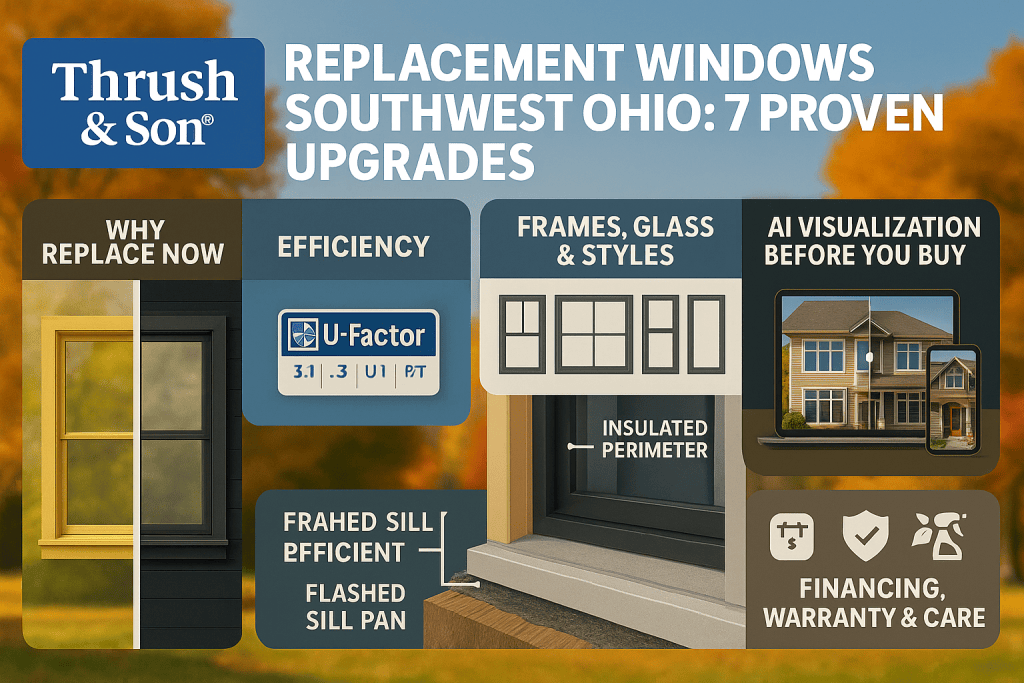
Replacement windows are custom-built to the eighth of an inch, and most can’t be returned. On a well-run job, a trained measurer checks every opening for square, level, and rot before anything is ordered, and the person who sold the job isn’t guessing from the driveway.
This is also the time to settle the details that are hard to change later: interior and exterior colors against your siding and trim, grid pattern, hardware finish, and screen type. Seeing samples on your own wall in daylight beats any showroom.

Family-Owned and Installing Since 1960
Thrush & Son® has installed replacement windows, roofing, siding, and doors on Miami Valley homes for three generations. Our crews measure, install, and stand behind the work, and the same family answers the phone when a question comes up years later.
See the full lineup on our replacement windows page, or keep reading:
Get Every Opening Measured Before You Decide
We’ll check every window for square, rot, and egress, bring samples to compare against your siding and trim, and quote replacement windows in writing, unit by unit.
- GAF President’s Club Contractor
- Best of Dayton 2024 Winner · 2025 & 2026 Finalist
- BBB Accredited A+
Michelle, our AI assistant, answers 24/7
Office: Mon–Thu 9–4, Fri 9–2
