Why Settle For Less? The Hidden Spacer That Makes or Breaks a Window
Why settle for less on the part of a window you’ll never notice until it fails? In Part 1, we walked through how windows evolved from a single pane to today’s vinyl replacement windows. Part 2 zooms in on the strip that holds it all together: the spacer.
It’s a fair question for any homeowner comparing quotes. Two windows can list the same glass, the same low-E coating, and the same argon fill, and still perform very differently after ten Ohio winters. The difference is usually at the edge. Why settle for less when the fix is simply asking the right question?

Why Settle For Less at the Edge of the Glass?
The middle of the glass gets all the attention: low-E coatings, argon, triple panes. But the edge is where most windows lose heat, collect condensation, and eventually fail. A spacer has four jobs, and it has to do all of them for decades, through hot July afternoons and January nights below zero. Why settle for less on any one of them?
- Holds the panes apart
Keeps the gap between the glass exactly the width the gas fill was designed for.
- Seals the edge
Works with the sealant to keep insulating gas in and outdoor moisture out.
- Carries the desiccant
Holds a drying agent that soaks up any moisture trapped inside, so the glass stays clear.
- Sets the edge temperature
Its material decides how much cold travels to the inside edge, where condensation starts.
How much heat the spacer carries
Relative conductivity, butyl rubber = 1 (log scale)Stainless steel is about 1/15 as conductive as aluminum; rubber is 120 times less conductive than stainless. Source: GreenBuildingAdvisor
Condensation resistance by spacer
Low-E insulated glass, higher is betterTesting by Enermodal Engineering, as reported by GreenBuildingAdvisor.
The first warm-edge spacer, Swiggle Seal, arrived in 1979. Since then, the industry has moved steadily away from aluminum, because a cold edge is where frost lines form along the bottom of the glass. If you’re fighting that every winter, read our window condensation guide and our post on severe condensation. Why settle for less than a warm edge when the rest of the window is doing its job?
The Stainless U-Channel: Why Settle For Less Then, and What’s Better Now
In 2015, this post championed the Intercept stainless steel spacer. Its maker, GED, describes it as a one-piece U-channel that flexes with the glass so there’s no load on the sealant, and cites argon loss of less than 0.1% per year in Rosenheim testing. See GED’s Intercept overview.
Spacers matter more in Ohio than in mild climates. Our freeze-thaw swings make the glass move more, and long heating seasons mean more hours with a cold edge on one side and humid indoor air on the other, sometimes for months at a time.
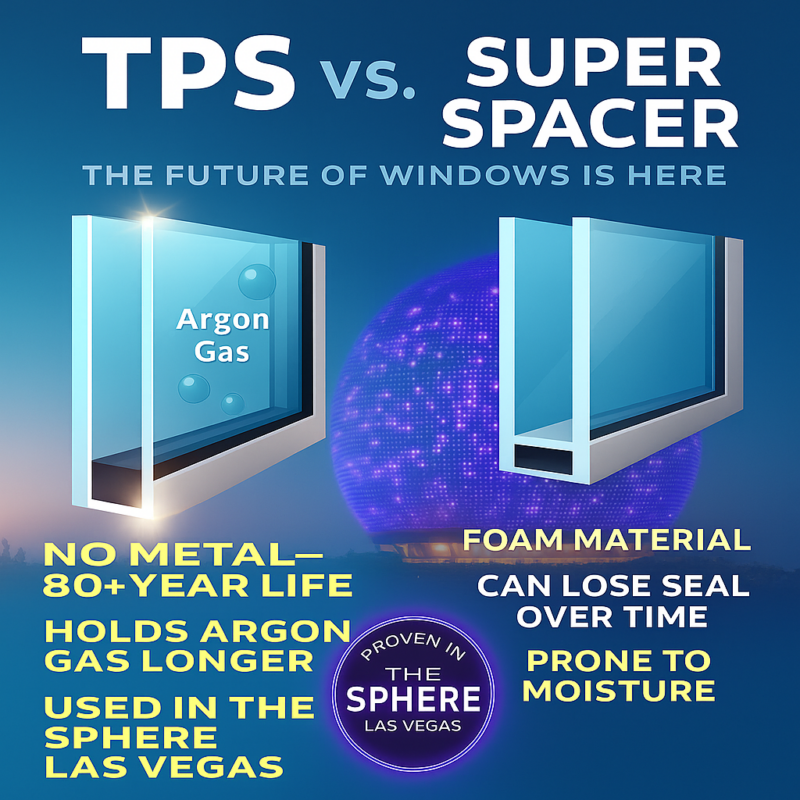
The U-channel was a big step up from aluminum box spacers. Today, non-metal options like TPS thermoplastic spacers go further, with no metal and no corner joints at all. The 2015 product promotion and home show dates are long gone; our Series 8000 then-and-now post covers that history. Why settle for less than the newest edge technology when you’re replacing windows for the next few decades?
How a Spacer Fails, Step by Step
Seal failure doesn’t happen overnight. It’s a slow chain reaction, and the spacer is where it starts. Why settle for less than an edge built to stop it at step one?
- Daily stress
Sun and cold make the glass expand and contract every day. A rigid spacer fights that movement and strains the sealant.
- Tiny leaks
Over years, the seal loosens. Insulating gas slowly escapes, and humid air works its way in.
- Wet desiccant
The drying agent inside the spacer soaks up moisture until it can’t hold any more.
- Fog you can’t wipe
Moisture condenses between the panes. The glass looks cloudy, and the window has lost much of its insulating value.
Red-Pen Review: Why Settle For Less on Paper?
Two window quotes with the same glass and very different fine print. Read them, decide which one you’d sign, and ask yourself: why settle for less than full disclosure? Then grab the red pen to see what a window pro would circle.
Same glass on paper, very different window in your wall. Quote B tells you what holds the glass together, how it handles condensation, and how long the seal is covered. Why settle for less than a quote that answers every line?
Five Questions That Answer “Why Settle For Less?”
- What material is the spacer, and is it warm edge?
- What condensation resistance rating does the NFRC label show?
- Is the glass filled with argon, and how is the gas kept in?
- How long is the insulated glass seal covered, and does that transfer to the next owner?
- Can I see the product literature with all of this in writing? Keep this list on your phone; it takes five minutes to ask.
Next in the series: Part 3, Meeting Rail Reinforcement, on what keeps a double-hung window straight and sealed. For more questions to ask at an estimate, see A Womans Perspective, and learn to read the NFRC label in Nine Interesting Facts.
Why Settle For Less? Spacer Questions, Answered
What homeowners ask us about the edge of the glass.
What is a window spacer?
It’s the strip around the edge of an insulated glass unit that holds the panes apart, seals in the gas fill, and carries a desiccant that keeps the space dry. You can usually see it as a thin band just inside the frame.
What is a warm-edge spacer?
Any spacer made from something less conductive than the old aluminum box spacer, such as stainless steel, butyl rubber, silicone foam, or thermoplastic. Stainless steel is about 1/15 as conductive as aluminum, according to GreenBuildingAdvisor.
Does the spacer really affect condensation?
Yes. In testing cited by GreenBuildingAdvisor, a low-E insulated glass unit scored 19.3 on condensation resistance with an aluminum spacer and 44.9 with a silicone foam spacer. A warmer edge means less fog and frost along the bottom of the glass.
How do I know which spacer is in a quote?
Ask. It should be written on the quote or the product literature. If the answer is “standard,” ask what material that means, and ask to see the NFRC label for the condensation resistance rating.
Can fog between the panes be fixed?
Not by wiping it. The moisture is sealed inside the glass unit. Depending on the window and its warranty, the insulated glass unit or the sash can often be replaced without replacing the whole window. If several windows are fogging, it’s usually a sign the seals are reaching the end of their life.
What spacer do Thrush & Son windows use?
Our Nobility vinyl windows use modern warm-edge spacer systems; your consultant will show you the exact glass package for your windows. See the Nobility brochure and the Nobility warranty, or read our TPS spacer post.
Why Settle For Less on Your Next Windows?
Why settle for less than knowing exactly what you’re buying? We’ll show you what’s in the glass package we recommend, spacer included, along with the NFRC numbers and the written warranty. Every quote is line by line, with no today-only pricing. Ask about financing, compare styles in our Exterior Design Center, or see finished homes in our project gallery.
Family owned since 1960, trusted by 31,000+ homeowners, BBB A+, Best of Dayton 2024 Winner, and a President’s Club Contractor.
Call 937-833-5136 · Office: Mon–Thu 9–4, Fri 9–2 · Michelle, our AI assistant, answers 24/7