
What’s Your House Wearing? A Roof Style Guide in 3 Cs
Roof style is the outfit your whole house wears. It’s the first shape people see from the street, and it frames everything below it: the siding, the windows, the front door.
Picking one comes down to three Cs we’ve used for years: Communicate, Complement, and Compare. Then step up to the runway to see six classic roof shapes and the shingle styles that finish the look.
The 3 Cs of Choosing a Roof Style
A roof isn’t something you change every few years. These three Cs keep the decision grounded in your house, your weather, and the long haul.
Communicate
Start with your contractor, local codes, and any HOA rules, which can limit slopes, colors, or materials. Talk about weather, too: snow, ice, and wind all favor some roof styles over others. Our roofing team handles the code questions.
Complement
Every home has architectural DNA. A Colonial wants symmetry, a farmhouse wants a strong gable, and a Prairie home wants a low hip. The right roof style makes the siding, windows, and door look intentional.
Compare
Compare shapes, shingle styles, and colors side by side. Look at full-size samples outside, and drive past homes with the shape you’re considering. Pick for decades, not for this season.
Six Roof Style Silhouettes
Tap a silhouette to send it down the runway: what it looks like, what kind of house wears it well, and how it handles Ohio weather.
The Gable
The lookTwo slopes meeting at a ridge, with a triangular wall at each end.
Wears well onColonials, Cape Cods, farmhouses, and most ranches.
Weather reportSheds rain and snow well. The Building America Solution Center notes gable ends need proper bracing, and gable roofs are more prone to wind damage than hips.
The Hip
The lookSlopes on all four sides meeting at a short ridge or a point.
Wears well onPrairie, Craftsman, and many brick ranches.
Weather reportWind tunnel studies cited by the Building America Solution Center found peak wind pressures can be up to 50% lower on a hip roof than a gable.
The Dutch gable
The lookA hip roof with a small gable perched on top.
Wears well onTraditional homes that want a little extra character.
Weather reportCombines a hip’s sloped sides with gable vents up high. More valleys and flashing to get right.
The Gambrel
The lookTwo slopes on each side, steep below and shallow above, like a classic barn.
Wears well onDutch Colonials and barn-style homes that want attic space.
Weather reportThe steep lower slope gives room for a second story; the shallow top needs careful underlayment.
The Mansard
The lookFour nearly vertical lower slopes topped by a low-slope roof.
Wears well onSecond Empire homes and some commercial buildings.
Weather reportThe steep sides often read as a wall of shingles, so color and texture matter even more.
The Shed
The lookA single slope, high on one side and low on the other.
Wears well onModern homes, additions, porches, and dormers.
Weather reportLow pitches can drop below what shingles allow and need a membrane instead.
Most real houses mix silhouettes: a hip roof with a gable over the entry, or a gable with a shed-roof porch. Every place two shapes meet is a valley or a wall that needs flashing done right; see parts of a roof. The weather notes come from the Building America Solution Center.
Shingle Styles That Finish the Look
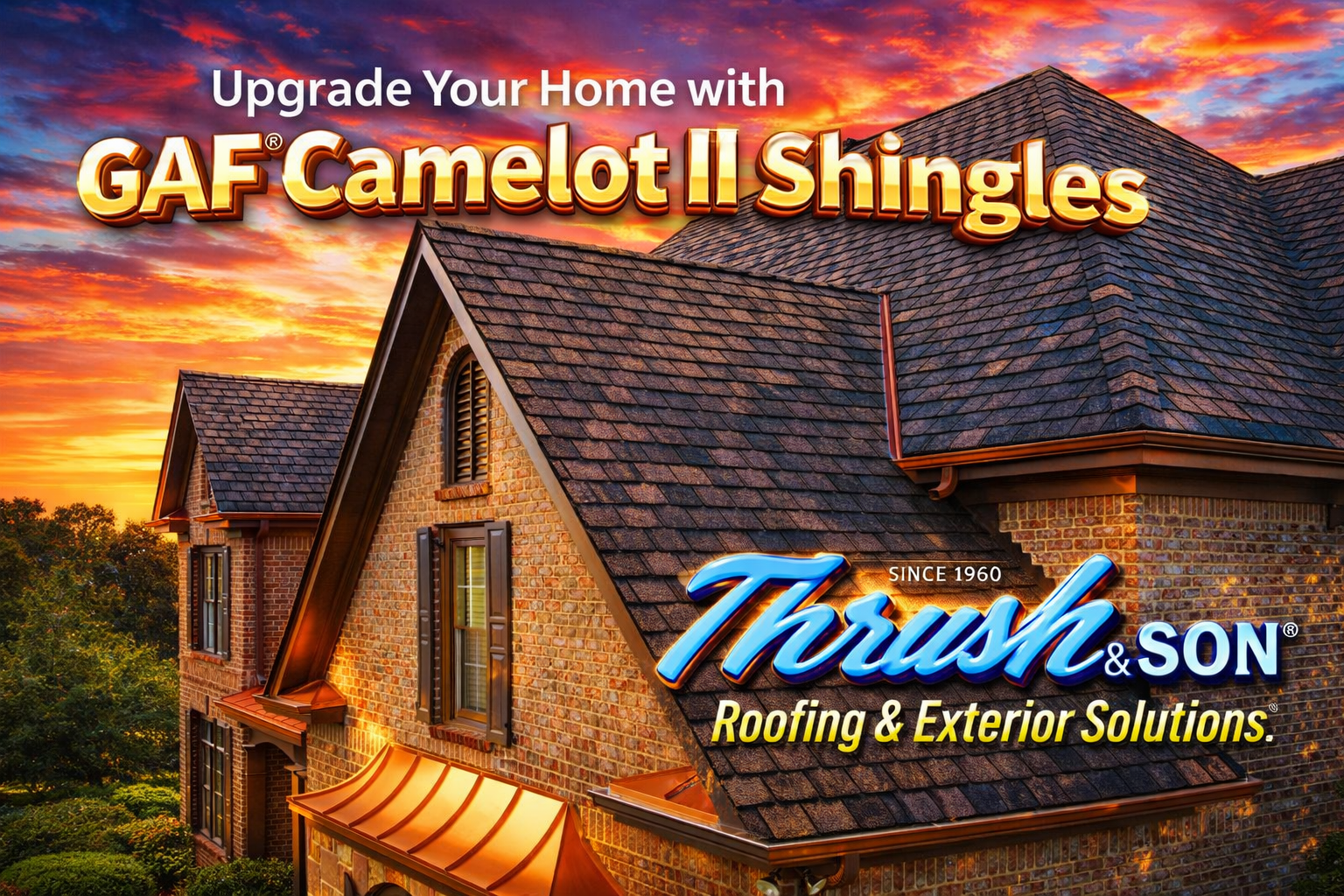
The shape is the outfit; the shingle is the fabric. These are the GAF styles we install, from everyday architectural to designer.


Color matters as much as texture; see top shingle colors. And because the roof is the biggest block of color on the house, choose it before the siding; our 5 exterior design ideas and choose a siding style guides explain why.
Why Roof Style Is a Long-Term Decision
The shape also affects how the attic breathes and how the roof sheds snow and water. Complex roofs with many valleys need more care at every seam, and good attic ventilation matters on every shape.
More project returns are in our home improvement ROI guide.

Styling Miami Valley Roofs Since 1960
Wilbur Thrush founded Thrush & Son in 1960. W. Allen Thrush owns the company today, and Corey Thrush is the third generation. More than 31,000 Miami Valley homeowners have trusted us, from our Brookville headquarters and offices in Troy and Lebanon.
As a GAF President’s Club Contractor, we install complete GAF roofing systems on every roof style, from simple gables to roofs with a dozen valleys. See our roofing services, storm damage help, the project gallery, and homeowner reviews.
Roof Style: Your Questions, Answered
What homeowners ask us most about roof style.
What are the most common roof styles?
Gable, hip, Dutch gable, gambrel, mansard, and shed. Most Miami Valley homes have gable or hip roofs, often combined with smaller gables, dormers, or porch roofs.
Which roof style is most wind resistant?
Hip roofs generally perform better in high winds. The Building America Solution Center cites wind tunnel studies showing peak wind pressures can be up to 50% lower on a hip roof than a gable roof, all else being equal.
Can I change my roof style during a replacement?
Usually a reroof keeps the existing shape, because changing the roof style means reframing. What you can change easily is the shingle style and color, which change the look more than most people expect.
What shingle styles do you install?
GAF Timberline HDZ, Timberline AS II, Camelot II, and Slateline. See our GAF roofing shingles guide and top shingle colors.
Does roof style affect home value?
The roof is a big part of curb appeal. In the latest Cost vs. Value report for our region, an asphalt shingle roof replacement recouped 69.2% of its cost at resale.
Do low-slope roofs need different materials?
Yes. Very low-slope sections, like some shed roofs and porches, need a membrane instead of shingles. We’ll check the pitch of every section during the estimate.
Book Your Roof Style Fitting
We’ll look at your roof’s shape, bring full-size shingle samples, and help you choose a style and color that fit the house. Then you get a written estimate with no pressure. See samples at our Exterior Design Center, and ask about financing.
Call 937-833-5136 · Office: Mon–Thu 9–4, Fri 9–2 · Michelle, our AI assistant, answers 24/7
Follow Along
New roofs every week, crew life, and BooBoo, our front-row critic. Meet the family here.
