
What We Said Then, What We Know Now
KWP Eco-Side was the engineered wood siding Corey Thrush walked through in our 2017 interview, and this page is our updated look at it. The video is still here, because the history matters. The difference is that we’ve added the context that the original clip didn’t have.
Below you’ll find the original claims next to our 2026 margin notes, what the warranty fine print actually says, and how engineered wood compares with cedar and insulated vinyl. One thing first: we no longer partner with KWP.
- To
- Homeowners researching siding
- From
- Thrush & Son®
- Re
- Editorial update & partnership clarification
Where We Stand on KWP Eco-Side Today
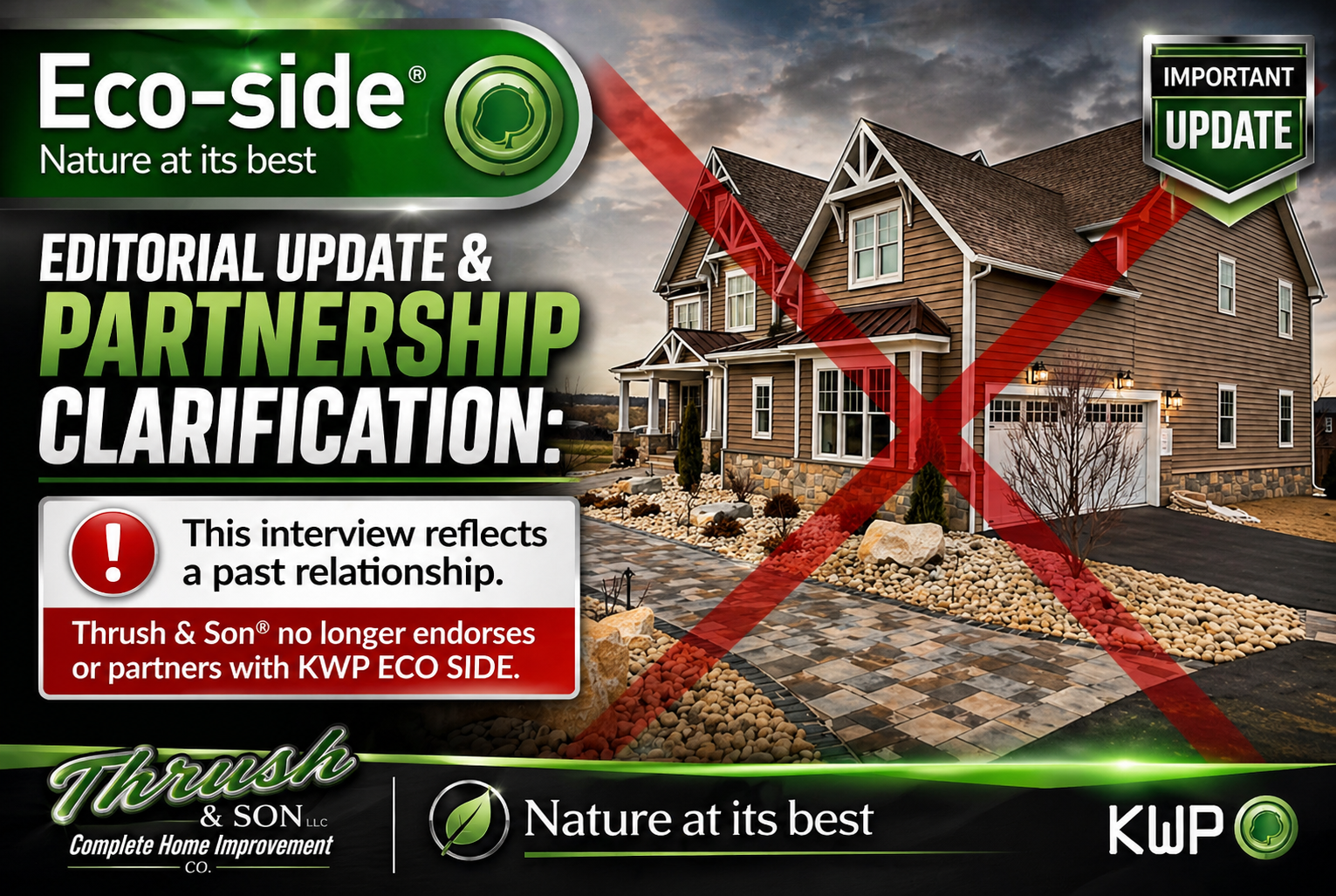
While this interview reflects a past business relationship, Thrush & Son® no longer endorses, promotes, or maintains a partnership with KWP Eco-Side or its products and brands.
Since the original publication, we’ve made strategic adjustments to align with evolving standards, product performance expectations, and long-term objectives for our customers. We periodically evaluate manufacturer relationships against our criteria for quality, reliability, innovation, and overall value.
At this time, we’ve chosen to move in a different direction for exterior siding partnerships. It reflects our commitment to continuous improvement and to recommending products that meet our current standards. A companion piece, our KWP interview, covers the rest of that conversation.
KWP Eco-Side Claims, Reviewed Line by Line
Here are six claims about KWP Eco-Side from the 2017 video and the product pitch. Switch between the original transcript and our 2026 margin notes.
“It has the natural feel and appearance of cedar.”
Embossed grain does read as wood from the curb. Today, though, cedar looks come in more materials, including insulated vinyl with a deep wood grain.
“The wood contains 100% pre-consumer recycled content.”
KWP’s 2023 brochure still lists 100% pre-consumer recycled wood and FSC certification.
“Unlike cedar, Eco-Side is resistant to rotting, splitting, and splintering, as well as termite damage.”
That resistance depends on the install. KWP’s installation guide calls for sealed cut edges, 2″ of clearance above roofs and decks, and gaps at trim.
“Without the hassle and maintenance.”
Less upkeep than cedar, yes. But the warranty still requires washing the siding at least once a year, and primed boards need paint.
“A 50|25 year warranty on all wood products.” (KWP brochure)
The Eco-Side limited warranty pays 100% only for the first 5 years, never covers labor, and doesn’t transfer to the next owner.
“Look no further than KWP Eco-Side.”
We did look further. We review every manufacturer regularly, and our siding work now centers on CertainTeed.
The KWP Eco-Side Warranty, Side by Side
“50 years” sounds simple. The details decide what it’s worth on the day you need it. Here’s the published KWP Eco-Side warranty next to the CertainTeed insulated siding warranty we work with today.
| Warranty detail | KWP Eco-SideLimited warranty, ©2015 | CertainTeed CedarBoards™Insulated siding, eff. 3/2023 |
|---|---|---|
| Length of coverage | 50 years on the siding substrate | Lifetime for the original owner-occupant |
| Full-value period | First 5 years; then it drops 2.22% a year | Non-prorated for the original individual owner |
| Labor | Excluded, even in the first 5 years | A refund can include original installation labor |
| If you sell the house | Not transferable | Transfers automatically, prorated to 50 years |
| Finish coverage | 25 years, factory-finished line only | Fade coverage beyond 4 Hunter units |
| Upkeep condition | Wash at least once a year | Normal cleaning and maintenance |
The biggest gap is transferability. If you might sell within a few decades, a warranty that ends at closing is worth less than its headline number. The second gap is labor, because tearing off and reinstalling siding often costs more than the boards themselves.
To be fair, every manufacturer warranty has conditions, and none of them covers poor installation. That’s why the contractor’s own workmanship guarantee matters as much as the paper from the factory. Ask for both in writing, and ask who you call if something goes wrong in year twelve.
For a plain-English look at how manufacturer and workmanship coverage fit together, read the warranty.
Cedar, Engineered Wood, or Insulated Vinyl?
The 2017 pitch was all about a cedar alternative, so here’s how the three cedar-look options compare. Engineered wood runs about half the price of real wood, while insulated vinyl is the most-used siding in Ohio’s region: 69% of new homes started in the East North Central states in 2024.
Natural cedar
- Look
- Real wood grain and smell
- Upkeep
- Stain or paint every few years
- Moisture
- Can rot, split, and attract insects
- Worth knowing
- The look everyone copies
Engineered wood
- Look
- Embossed cedar grain
- Upkeep
- Primed boards need paint; seal cut edges
- Moisture
- Resists rot when installed to the letter
- Worth knowing
- About half the price of real wood
Insulated vinyl
- Look
- Deep wood grain, factory color
- Upkeep
- Rinse with a hose and soapy water
- Moisture
- Won’t rot; foam backing adds R-2.0 to 2.7
- Worth knowing
- Most-used siding in new Ohio-region homes
Foam-backed vinyl adds an R-value of 2.0 to 2.7, according to CertainTeed, and it never needs paint. Want the whole case? Read about vinyl siding, vinyl siding durability, and our insulated siding guide.
An Engineered Wood Install Checklist
Maybe you prefer the look, or your HOA requires wood. That’s fair. Engineered wood is less forgiving of shortcuts than vinyl, and the JLC field guide calls out installation errors as a leading cause of trouble.
Use this list when you interview installers. Each item comes from KWP’s own pro pack or the JLC guide. Check them off as your contractor confirms each one.
If someone shrugs at the cut edges or the roof clearance, keep looking.
Four Signs Engineered Wood Siding Needs Attention
Plenty of homes around the Miami Valley already have engineered wood siding, and many of them look great. If yours is one of them, walk around the house twice a year, in spring and fall, and look for these four things.
Swollen bottom edges
Drip edges and the lowest course take the most water. Flared or fuzzy edges usually mean moisture got past the paint.
Peeling or chalky paint
Paint is the shield on primed boards. Once it fails, the wood fiber underneath starts drinking water.
Trouble near roofs and decks
Boards that touch a roof, deck, or patio wick up water. Look for staining or softness where clearance is missing.
Open joints and caulk gaps
Butt joints and trim gaps should stay sealed. Cracked caulk lets wind-driven rain into the wall.
Catching any of these early usually means touch-up paint and fresh caulk, not new walls. Waiting a few winters can turn one soft board into a whole elevation. Whatever you find, take a photo and note the date. It helps any warranty claim, and it helps us give you a clear answer faster.
The Original 2017 KWP Eco-Side Interview
In this clip, Corey Thrush explains why KWP Eco-Side appealed to homeowners in 2017: a cedar look, recycled wood content, and better resistance to rot and termites than natural cedar.
Watch it as a record of that moment. The redline above shows which points still hold and which need context today.


Siding That Fits Our Standards Today
Our siding work now centers on CertainTeed, including insulated lines that add a layer of foam behind the panel. They come in cedar-look profiles, board and batten, and a deep color range. See siding colors for ideas.
If you’re replacing engineered wood or any aging siding, we’ll inspect the walls, flag moisture issues early, and put every option in writing. Start with our siding replacement page or browse the project gallery.
Why We Revisit Old Advice
Thrush & Son® has been family owned since Wilbur Thrush started the company in 1960. Three generations later, we serve Miami, Montgomery, Greene, and Warren counties from Brookville, Troy, and Lebanon. Updating pages like this one is part of standing behind what we say. Read 65 years strong.
See what homeowners say in our reviews and on our BBB profile.

KWP Eco-Side FAQs
What is KWP Eco-Side?
KWP Eco-Side is an engineered wood siding made by KWP. Its brochure describes 100% pre-consumer recycled wood with added binders, pre-primed or prefinished boards, and a cedar-like grain.
Does Thrush & Son still install KWP Eco-Side?
No. This interview reflects a past business relationship. Thrush & Son® no longer endorses, promotes, or maintains a partnership with KWP Eco-Side or its products and brands.
Why did you move away from KWP Eco-Side?
We regularly review manufacturers for quality, reliability, innovation, and value. After that review, we chose a different direction for exterior siding partnerships.
What does the KWP Eco-Side warranty cover?
The limited warranty covers the substrate for 50 years, at full value for the first 5 years and prorated after that. Labor is excluded, and the warranty doesn’t transfer to a new owner.
I already have KWP Eco-Side. What should I do?
Keep it washed once a year, keep paint intact, and watch the bottom edges and any spots near roofs or decks. If boards swell or the paint fails, call us for an inspection and a clear look at your options.
What siding does Thrush & Son install today?
Our siding work centers on CertainTeed, including insulated lines. See our siding replacement page or read our guide to insulated siding.
Compare Your Siding Options With Us
Whether you have KWP Eco-Side today or you’re starting fresh, we’ll walk your home, explain the trade-offs, and give you a written estimate with no pressure. Ask about financing.
